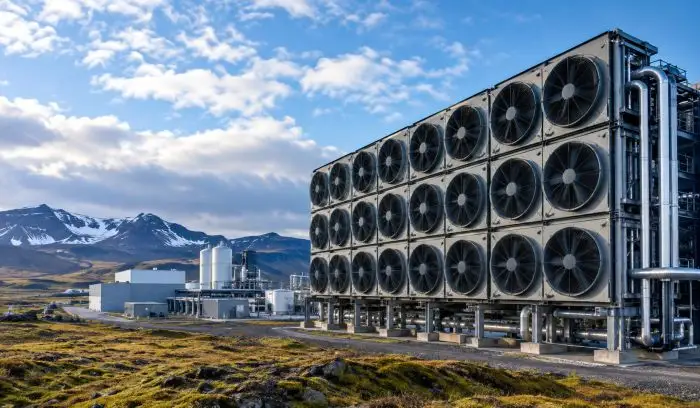
Carbon removal technology innovations are moving faster than most people realize. New machines now pull CO2 straight from the open air. Solid sorbents last longer and capture more. Electrochemical systems use electricity instead of heat. Costs are falling every year.
Companies like Climeworks and Heirloom are building bigger plants. Governments are passing laws to support this work. The goal is simple. Take carbon out of the sky. Store it safely. Undo some of the damage we caused. This is not a small effort. It is a global race. And the carbon removal technology innovations we see today are just the beginning.
What is Direct Air Capture and How Does It Work?
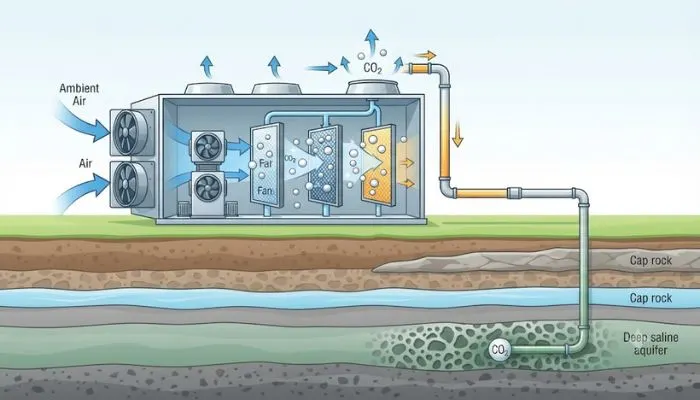
Direct air capture (DAC) is a machine that sucks CO2 out of the sky. It works like a giant filter. Fans pull air into a contactor. The air passes over a special material. That material grabs the CO2. Clean air goes out the other side .
Once the material is full, the machine closes. Heat or vacuum releases the CO2. The material is ready to use again. The CO2 is then stored underground or used to make things .
The process is simple in theory. But it is hard in practice. CO2 in the air is very thin. It is about 400 parts per million. That is 300 times weaker than in a smokestack . This makes DAC energy-hungry. You need a lot of power to pull it out.
Read More: How Green Hydrogen Is Produced From Water | Complete Guide
Direct Air Capture vs Carbon Capture
People mix these up. They are not the same.
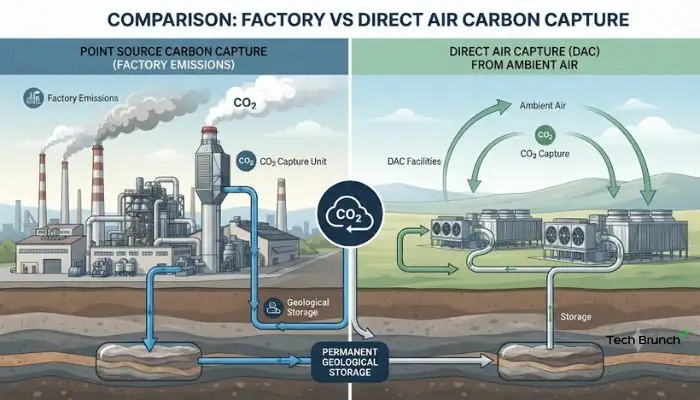
- Carbon capture catches CO2 at the source. Think of a factory chimney. The CO2 is strong there. It is easy to grab. This stops new pollution from entering the air .
- Direct air capture catches CO2 that is already outside. The air is thin. The CO2 is weak. It is much harder to grab. But DAC cleans up past messes. It removes what we already put in the sky .
Carbon capture is carbon neutral. It keeps the air the same. DAC is carbon negative. It makes the air cleaner .
Carbon Removal Technology Innovations in the World
New tech is popping up everywhere. Here are the biggest breakthroughs.
Solid Sorbents Get Better
- Most DAC plants use solid materials to grab CO2. These are called sorbents. Old sorbents broke down fast. They lost power when heated .
- Korean scientists fixed this. They added a special compound to the sorbent. This protects it from heat damage. Their new material recovered CO2 at 96.5% purity. It ran for 350 hours without breaking .
This matters. Better sorbents mean lower costs. Lower costs mean more plants. More plants mean more carbon removed.
Electrochemical Capture Uses Less Energy
- Most DAC uses heat to release CO2. That takes a lot of energy. A new device from the University of Illinois uses electricity instead .
- The device changes the pH of a saltwater solution. When the water is alkaline, it absorbs CO2. When it shifts back, the CO2 bubbles out. This method runs on batteries. It can use renewable power .
This is big. Heat is expensive. Electricity from solar and wind is cheap. This could cut DAC costs by a lot.
Absorption-Based Systems
- Carbon Engineering uses a different approach. Their system uses a liquid solution. Air passes through the liquid. The CO2 gets trapped. Then it goes through a calcium loop. This releases the CO2 and regenerates the liquid .
- This method is proven. It works at scale. The company is building large plants in Texas and other places.
Rotating Bed Contactors
A new design uses a rotating bed. The bed spins between two zones. One zone captures CO2. The other releases it. This allows continuous capture. No need to stop and start .
This is a small change. But it makes the system simpler. Simpler systems cost less to build and run.
Carbon Removal Technology Companies
Many companies are racing to build DAC plants. Here are the key players.
- Climeworks runs the biggest DAC plant. It is called Mammoth. It sits in Iceland. It can capture 36,000 tons of CO2 per year. That is ten times bigger than its old plant Orca .
- Carbon Engineering uses liquid absorption. They are building large plants in the US. Their tech is proven and scalable .
- Heirloom uses limestone to capture CO2. Limestone is cheap and abundant. Their process is simple and low-cost.
- Airhive just acquired Carbyon. Both are European DAC companies. Airhive’s system captured CO2 at under $500 per ton. That is a breakthrough. Most DAC costs $600 to $1,000 per ton .
- Phlair is a German company. They built an electrochemical DAC system. It runs on solar power. They signed deals with Google, Stripe, and H&M .
- Frontier is a coalition backed by Stripe, Google, and others. They just added $915 million to their fund. This brings their total to $1.8 billion. They buy carbon removal credits in advance. This helps companies grow .
Carbon Dioxide Removal Machine from Human Body
This is a different kind of carbon removal. It is medical, not climate. But it is an innovation worth knowing.
- COPD patients cannot breathe out enough CO2. It builds up in their blood. This can kill them. A machine called an artificial lung can help.
- X-COR Therapeutics is building a device like an artificial kidney. It pulls blood out of the body. A filter removes CO2. Then the blood goes back in. This could replace mechanical ventilators. Ventilators damage lungs over time.
The device uses low blood flow. It is less invasive. It could be portable. Patients could walk around while using it. This would change lives for people with severe lung disease .
You May Also Read: Climate Tech vs Green Tech: Understanding the Key Difference
The Future of Carbon Removal

- Carbon removal is not a silver bullet. It cannot fix everything. We still need to cut emissions. We need to stop burning fossil fuels. But carbon removal is a tool we need.
- The IPCC says we need to remove 6 gigatons of CO2 every year by 2050. That is a huge number. Today we remove almost nothing. We need to scale up fast .
- The good news is that costs are falling. New materials are better. New processes use less energy. Companies are building bigger plants. Governments are passing laws to support this.
The US has a tax credit called 45Q. It pays companies to capture and store CO2. The EU has a certification framework. Japan added DAC to its emissions trading scheme .
FAQs
1. What is carbon removal technology?
It is tech that pulls CO2 out of the air. Simple. Trees do it. Machines do it too. The goal is to clean up the mess we made. We put too much carbon in the sky. This tech takes it back out. It stores it underground. Or uses it to make stuff. That is the basic idea.
2. How does direct air capture work?
Fans pull air into a machine. The air passes over a special material. That material grabs the CO2. Clean air goes out. Then the machine heats up. The CO2 comes loose. It gets pumped underground. The material is ready again. That is the loop. It runs over and over.
3. What is the difference between direct air capture and carbon capture?
Carbon capture grabs CO2 at the source. A factory chimney. The CO2 is strong there. Easy to catch. Direct air capture grabs CO2 from the open air. The CO2 is weak there. Very thin. Hard to catch. Carbon capture stops new pollution. Direct air capture cleans up old pollution.
4. Why is direct air capture so expensive?
Because CO2 in the air is thin. It is about 400 parts per million. That is weak. You need to push a lot of air through the machine. That takes energy. Energy costs money. The materials cost money too. But costs are dropping. New tech is helping.
5. Which companies are working on carbon removal?
Climeworks runs the biggest plant. It is in Iceland. It is called Mammoth. Carbon Engineering uses liquid systems. Heirloom uses limestone. Airhive and Phlair are new players. Frontier funds them all. Google, Stripe, and others pay for carbon credits upfront. This helps these companies grow.
6. Can a machine remove CO2 from the human body?
Yes. It is a medical device. Not for climate. For sick people. COPD patients cannot breathe out CO2. It builds up in their blood. X-COR Therapeutics is building a device. It pulls blood out. A filter removes CO2. Blood goes back in. This could replace ventilators. Ventilators damage lungs. This device is gentler.
7. What are the newest innovations in carbon removal?
Solid sorbents are getting better. Korean scientists made one that lasts longer. Electrochemical capture uses electricity instead of heat. That is cheaper. Rotating bed contactors run nonstop. Absorption systems use liquids. Each one cuts costs. Each one makes the tech better.
8. Is carbon removal the answer to climate change?
No. It is one tool. We still need to cut emissions. We cannot keep polluting and just clean it up later. That does not work. But we do need carbon removal. The IPCC says we need 6 gigatons per year by 2050. We are far from that. We need to scale up fast. Cut emissions first. Remove carbon second. Both matter.