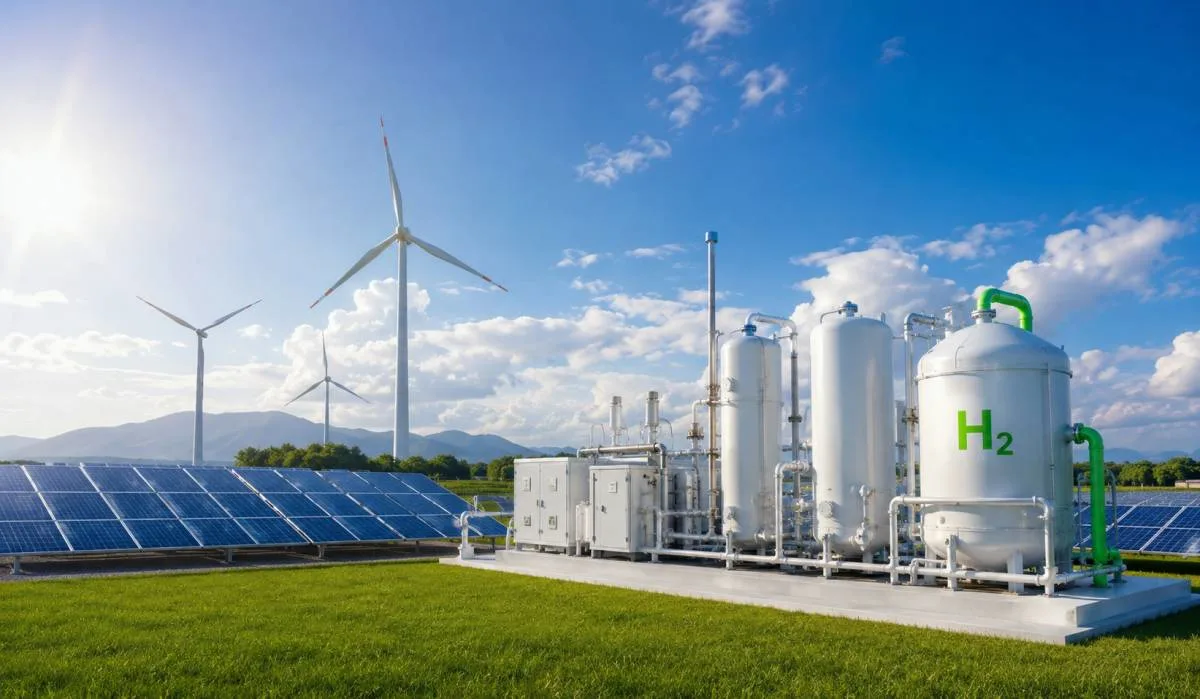
How green hydrogen is produced from water is a question more people are asking. The answer is simple. It is just splitting water into hydrogen and oxygen. That is the simple version. You take H2O and break it apart. You get H2 and O2. The process is called electrolysis .
But the key part is the electricity you use. If that electricity comes from renewable sources like solar or wind, the hydrogen is called green hydrogen . No fossil fuels are burned. No carbon comes out. That is what makes it green .
What is Green Hydrogen?
Green hydrogen is hydrogen made without fossil fuels . The government of India set a standard. For hydrogen to be called green, the total emissions cannot be more than 2 kg of CO2 for every 1 kg of hydrogen produced .
This is a strict rule. It makes sure the process is actually clean. Most hydrogen today is grey hydrogen. That is made from natural gas. It releases a lot of carbon. Green hydrogen is different. It is clean from start to finish.
Read More: Climate Tech vs Green Tech: Understanding the Key Difference
Green Hydrogen Production by Electrolysis
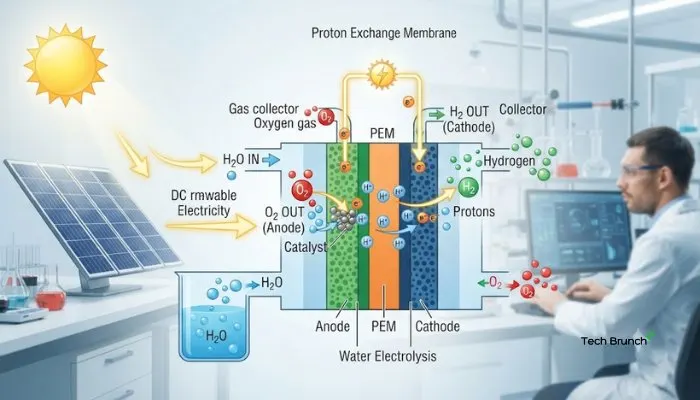
This is the main way we make green hydrogen. You run electricity through water. The electricity splits the water molecules. Hydrogen bubbles form at one end. Oxygen bubbles form at the other . That is all.
The electricity must come from renewable sources. Solar panels work well. Wind turbines work well . They give clean power. The electrolyzer does the splitting. There are different types of electrolyzers.
- Alkaline electrolyzers are the oldest type. They are mature. They are reliable. They use a liquid electrolyte .
- PEM electrolyzers are newer. They respond quickly. They work well with renewable energy. The downside? They need iridium. Iridium is rare. It is expensive. This creates a supply problem .
- Solid oxide electrolyzers work at very high temperatures. They are efficient. They can even use seawater . They are still in research. Not commercial yet.
How Green Hydrogen is Used as Fuel?
Hydrogen is a fuel. It burns. It gives energy. The only byproduct is water vapor . That is why it is clean.
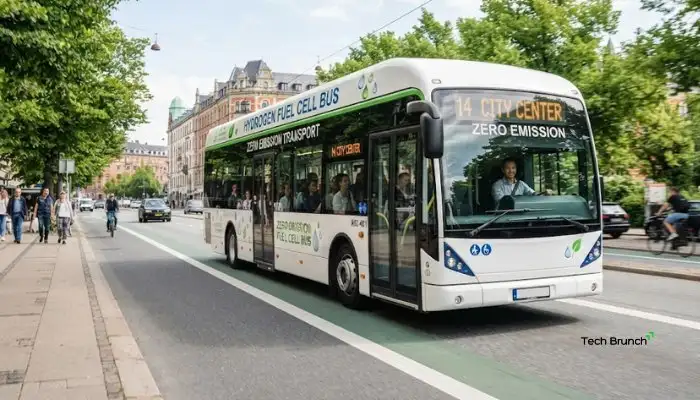
- Cars and trucks can run on hydrogen. Fuel cells turn hydrogen into electricity. That electricity powers the motor. The range is good. A full tank can get you about 400 miles . The problem is finding a place to fill up.
- Buses and trains are also using hydrogen. Heavy transport is a good fit. Batteries are too heavy for big vehicles. Hydrogen works better.
- Rockets use hydrogen too. The Japanese H-II and H3 rockets use hydrogen as fuel . It gives a lot of thrust.
- Industry uses hydrogen as a feedstock. It is used to make fertilizer. It is used in chemical plants . Right now, they use dirty hydrogen. Green hydrogen can replace it.
- Energy storage is another use. Renewable energy is not always available. The sun does not always shine. The wind does not always blow. You can take the extra energy and make hydrogen with it. Store it. Use it later when you need power .
How to Get Hydrogen from Water Without Electricity?
This is a big question. Can we skip the electricity? The answer is yes, but it is different.
- Photocatalysis is one way. You use sunlight directly. No electricity is needed. The sunlight hits a special material. That material splits water . This is still in research. It is not commercial yet. But it has promise. It could be very cheap. You just need sunlight and water.
- Thermochemical processes are another route. You use heat. Very high heat. Concentrated solar power can provide it. The heat drives chemical reactions. Those reactions split water . This is also early stage.
Green Hydrogen Production in India
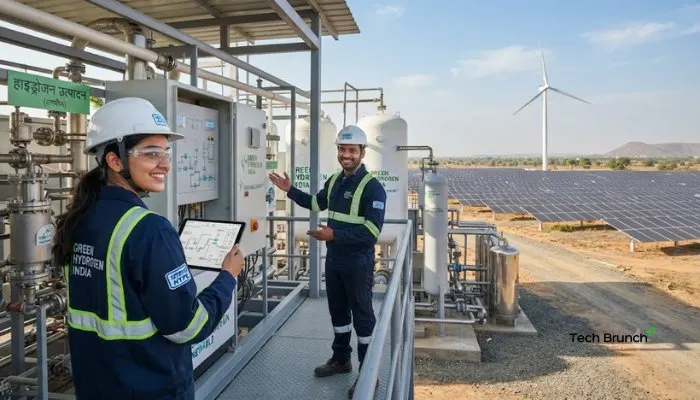
- India is going big on green hydrogen . The government launched the National Green Hydrogen Mission in January 2023. The budget is 19,744 crore. This is a serious investment.
- The goal is to make India a global hub for green hydrogen. They want to produce it. They want to use it. They want to export it. By 2030, they aim for 125 GW of new renewable energy for hydrogen production . That is a lot of solar and wind.
- They are also building manufacturing. As of May 2025, 19 companies got production allocations. That adds up to 862,000 tonnes of green hydrogen every year . They are also making electrolyzers. 15 firms got awards for 3,000 MW of manufacturing capacity .
- Pilot projects are running. They are testing hydrogen in steel plants. They are testing it in mobility and shipping . Three major ports are being developed as green hydrogen hubs. Deendayal Port, V.O. Chidambaranar Port, and Paradip Port .
- The cost is still a challenge. Green hydrogen costs about $3.5 to $5 per kg in India. Grey hydrogen costs $2.3 to $2.5 per kg . It is more expensive. But costs are coming down. Research is making things better.
You May Also Read: Importance of Green Technology in Modern Society Today
Final Thoughts
Green hydrogen is not a dream. It is happening now. The technology is simple. Split water with clean electricity. Use it as fuel. The only emission is water.
The challenges are real. Cost is high. Electrolyzers are expensive. Renewable power is not always available. But we are solving these issues. Research is ongoing. New methods are emerging. Decoupled electrolysis is promising. It works better with intermittent renewables . Photocatalysis could skip electricity altogether .
India is all in on this. The National Green Hydrogen Mission is a big bet. It will create jobs. It will reduce fossil fuel imports. It will cut emissions . The future is green. And it is powered by hydrogen.
FAQs
1. What is green hydrogen?
It is hydrogen made without dirty energy. Simple. You split water into hydrogen and oxygen. You use electricity to do it. But that electricity has to come from the sun or wind. That is what makes it green. If you use coal or gas power, it is not green. That is grey hydrogen. Green is clean.
2. How green hydrogen is produced from water?
You run electricity through water. Tht is it. The electricity breaks the water apart. Hydrogen comes out one side. Oxygen comes out the other. The machine that does this is called an electrolyzer. It needs two things. Water and clean electricity. Give it those. It gives you hydrogen.
3. How is green hydrogen used as fuel?
You burn it. Or you put it in a fuel cell. A fuel cell turns hydrogen into electricity. That electricity runs a motor. Cars use this. Trucks use this. Buses use this. Even trains are using it. The best part? The only thing that comes out is water. No smoke. No carbon. Just water.
4. Can we get hydrogen from water without electricity?
Yes. But it is not easy. One way is photocatalysis. That uses sunlight directly. No electricity needed. The sun hits a special material. That material splits the water. It is still in the lab. Not ready for your garage. Another way is heat. Very high heat. It drives chemical reactions. Also early stage.
5. What is green hydrogen production in India like?
India is going big. The government started the National Green Hydrogen Mission. The budget is almost 20,000 crore. They want to make India a global hub. By 2030, they want 125 GW of new renewable power just for hydrogen. That is huge. Companies are already building plants. Ports are becoming hydrogen hubs. It is happening.