Cloud bills keep growing. Many companies waste money without knowing it. Enterprise FinOps tools for cloud spending fix that. They show where money goes. They split costs by team. They find savings. Microsoft, Datadog, and AWS lead the market. CloudZero is best for cost per customer. Kubecost handles containers.
Free tools work too. Native cloud dashboards. OpenCost. finops-scan. This guide covers the top platforms and free options. Start with free tools. Buy a platform when the gaps cost more than the tool.
What Enterprise FinOps Tools Do?
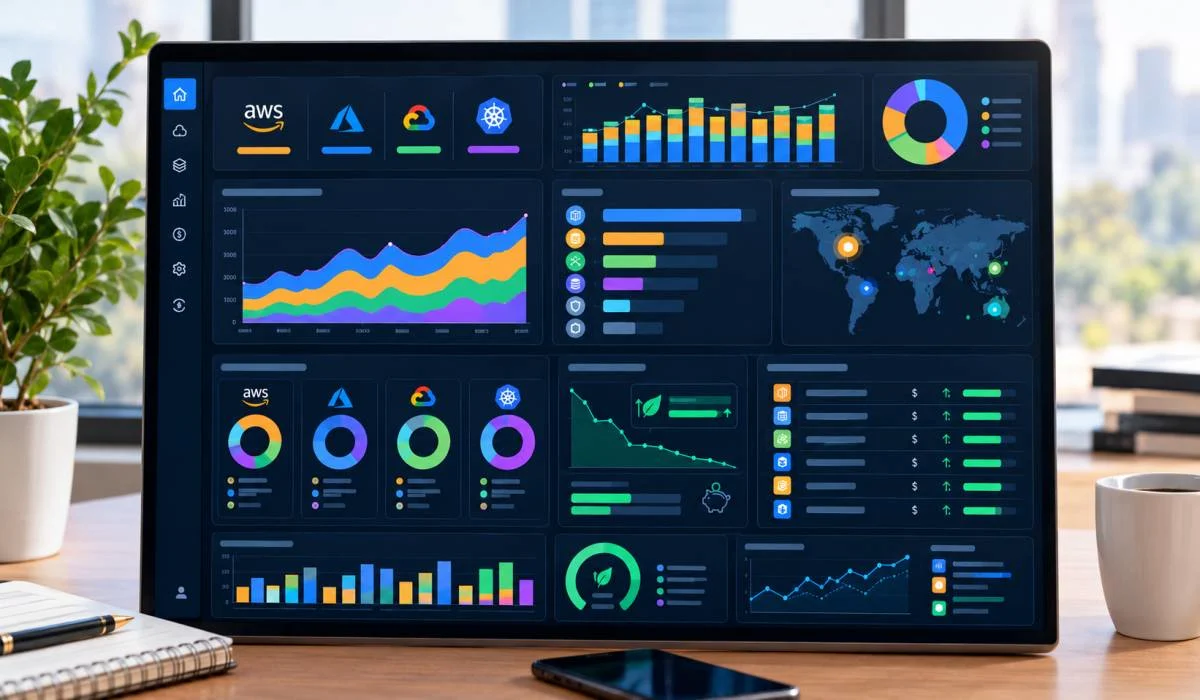
FinOps platforms will show you and manage your cloud spending. They integrate with your cloud resources (AWS, Azure, Google Cloud) and retrieve the billing information. Afterwards, they dissect that information by team, product or customer.
They also identify anomalies, predict spending amounts, and suggest saving. The market is a grownup market. According to ISG's 2026 Buyers Guide, the top-three overall providers are Microsoft, Datadog and AWS. So, the change now is from reporting to forecasting and optimizing continuously with the help of AI.
Read More: Enterprise AI Automation Tools for Companies: 2026 Guide
Top Enterprise FinOps Platforms
Microsoft (Cost Management + FinOps)
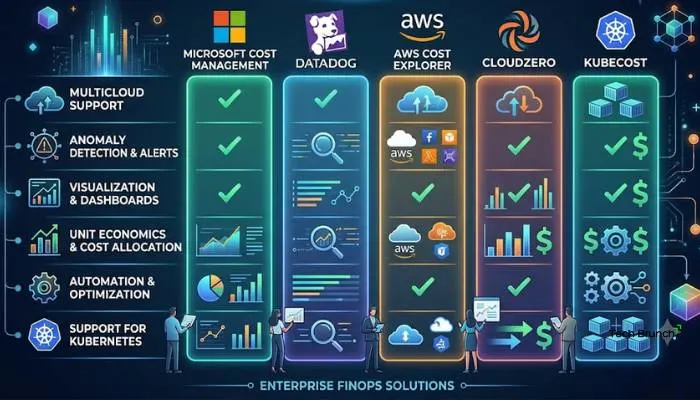
Microsoft topped ISG's overall rankings. It earned Leader status in five categories . Its native Azure Cost Management is free for Azure users. It offers cost analysis, budgets, alerts, and optimization recommendations. It also supports export to Power BI for custom reporting .
Best for: Organizations already deep in the Microsoft ecosystem. The native tools are a strong starting point before buying third-party software.
Datadog Cloud Cost Management
Datadog ranked second overall in ISG's guide . Its advantage is embedding cost data directly inside the observability platform engineers already use. You can correlate cost with performance metrics, traces, and logs without switching tools .
Best for: Engineering teams already using Datadog for monitoring. It makes cost a natural part of the engineering workflow.
AWS Cost Explorer and Budgets
AWS ranked third overall . Cost Explorer is free and provides interactive reporting, forecasting, and rightsizing recommendations. Budgets adds threshold alerts and automated actions .
Best for: AWS-native organizations. It is free and deeply integrated, but lacks multi-cloud support and deep business-level attribution.
CloudZero
CloudZero focuses on unit economics. It maps infrastructure costs to business metrics like cost per customer, cost per feature, or cost per team. This helps SaaS companies understand how infrastructure costs relate to revenue .
- Pricing: $19 per $1,000 of cloud spend under management. A $100K/month bill costs about $1,900/month. Minimum 12-month contract .
- Best for: Fast-growing SaaS companies with $100K+/month spend that need to understand cost per customer for pricing decisions.
Apptio Cloudability (IBM)
Cloudability is a veteran in finance-oriented FinOps. It excels at accounting-grade reporting, showback/chargeback, and commitment tracking. Its integration with Apptio's Technology Business Management (TBM) appeals to enterprises already managing IT finances with that ecosystem .
Best for: Large enterprises with cloud spend above $5 million. Implementation is heavier and often requires support .
CloudHealth (Broadcom)
CloudHealth focuses on multi-cloud governance. Its strength is policy enforcement at scale: tagging rules, access controls, compliance. It suits large accounts that prioritize governance and compliance alongside optimization .
Best for: Large enterprises prioritizing governance and compliance in complex multi-cloud environments.
Kubecost
Kubecost specializes in Kubernetes costs. It drills down to the container, namespace, and pod level, letting you attribute costs precisely and find inefficiencies . Its open-source core, OpenCost, provides a free way to start .
Best for: Organizations with heavy containerized workloads.
Finout
Finout unifies multi-cloud and SaaS spend quickly with a "MegaBill" that aggregates AWS, Azure, GCP, Snowflake, Datadog, and Kubernetes. It requires no agents to deploy, making setup fast .
Best for: Organizations wanting fast cross-cloud visibility, including SaaS spend often overlooked.
Free Enterprise FinOps Tools
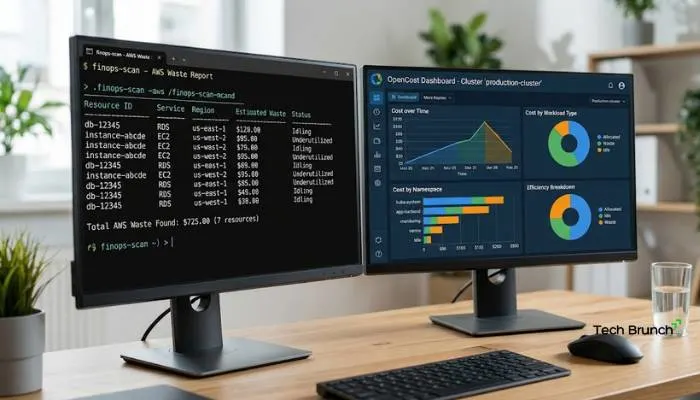
You do not need a big budget to start. Several free and open-source options exist.
finops-scan
This is a free, open-source CLI tool. Run one command and it scans your AWS account for waste in 60 seconds. It produces a ranked waste report with estimated savings, top services by spend, and tag coverage scores. It is read-only, stores no data, and requires no CUR or S3 setup .
Best for: Quick AWS waste checks without any setup.
OpenCost
OpenCost is the open-source project behind Kubecost. It provides real-time cost allocation by Kubernetes cluster, node, namespace, or pod. It supports multi-cloud monitoring for AWS, Azure, and GCP. It is free and Apache 2.0 licensed .
Best for: Kubernetes cost visibility without paying for a commercial tool.
Native Cloud Tools
AWS Cost Explorer, Azure Cost Management, and Google Cloud Billing are all free. They are the right starting point for most organizations. ISG and CloudZero both note that most teams outgrow them within 6–12 months as attribution gaps become costly .
You May Also Read: Enterprise Technology Trends: What Is Shaping Business in 2026
How to Choose?
- Start with native tools. They are free and already connected. Use them to understand your baseline.
- Move to a platform when you hit walls. When tagging is incomplete, shared costs are unattributed, and engineering has no visibility into what they ship, you need a dedicated tool .
- Match the tool to your problem. CloudZero for unit economics. CloudHealth for governance. Kubecost for containers. Finout for fast multi-cloud unification.
- Check the pricing model. Some charge a percentage of spend. Others charge per resource. nOps and North offer savings-based pricing, where you pay a percentage of what they save you . This aligns incentives but can cost more at scale.
The Bottom Line
Enterprise FinOps tools are essential for controlling cloud spend. Start with the free native tools. They are good enough for basic visibility. When you need unit economics, multi-cloud unification, or Kubernetes depth, move to a dedicated platform. Microsoft, Datadog, and AWS lead the market. CloudZero leads for business-level attribution. Kubecost leads for containers.
Free options like OpenCost and finops-scan let you start without a budget. Use them to find quick wins. Then invest in a platform when the gaps become too costly to ignore.
FAQs
1. What are the top FinOps tools in 2026?
ISG ranks Microsoft, Datadog, and AWS as overall leaders. CloudZero leads for unit economics. Apptio Cloudability leads for finance-grade reporting. Kubecost leads for Kubernetes costs .
2. Are there free FinOps tools?
Yes. Native cloud tools (AWS Cost Explorer, Azure Cost Management, GCP Billing) are free. OpenCost is free for Kubernetes. finops-scan is a free open-source CLI for AWS waste detection .
3. What is the best FinOps tool for startups?
Start with native cloud tools. They are free and sufficient for basic visibility. When you outgrow them, look at Finout for fast multi-cloud unification or CloudZero if you need cost per customer.
4. What is unit economics in FinOps?
It means measuring cost per business outcome: cost per customer, per feature, per transaction. CloudZero is built around this. It helps SaaS companies understand if infrastructure costs align with revenue .
5. What is Kubecost?
A FinOps tool specialized in Kubernetes. It allocates costs down to the pod and namespace level. Its open-source core, OpenCost, is free. The commercial version adds more features .
6. How much do FinOps platforms cost?
Varies. CloudZero charges $19 per $1,000 of cloud spend. North charges a flat platform fee plus a percentage of savings . Most enterprise platforms require custom quotes.
7. When should I buy a FinOps platform?
When native tools no longer answer your questions. Signs: incomplete tagging, unattributed shared costs, engineering has no cost visibility, and you need multi-cloud or Kubernetes attribution. Most teams hit this within 6–12 months .