
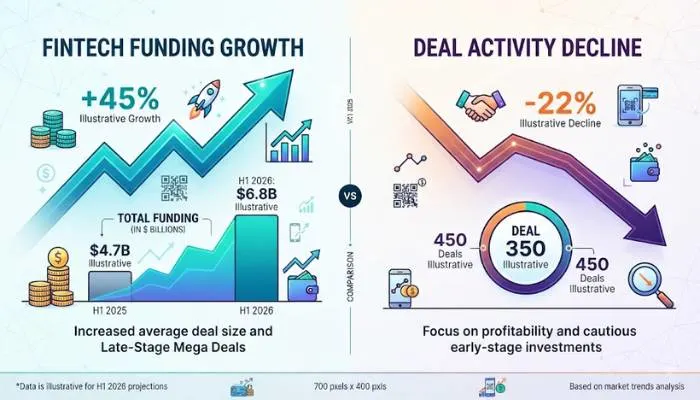
The Indian fintech sector has raised $2 billion so far in the first half of 2026. This is 42% more than last year. But, the number of funded companies decreased from 186 to 106. The bulk of the funds went to big, established companies. The story that Fintech startup funding 2026 tells is clear.
Investors are taking a conservative approach. They prefer that they grow up with the companies that have revenue and compliance. Startups in early stages are not doing well. Seed funding fell 42% to $68.6 million. The start-up level dropped 43% to $367 million. The city of Bengaluru had 70% of the total fintech investment. Big deals were done by CRED, KreditBee and Juspay. The article dissects the situation and what it means for founders.
The Big Numbers for H1 2026
The $2 billion raised in the first half of 2026 marks a strong recovery . But the growth is driven almost entirely by late-stage deals. Late-stage funding jumped 331% from the second half of 2025 to $1.6 billion . Meanwhile, seed-stage funding fell 42% year-on-year to $68.6 million. Early-stage funding dropped 43% to $367 million .
Investors are playing it safe. They are putting money into companies that already have scale, revenue, and a clear path to an IPO . This is not necessarily a bad thing according to industry watchers. It reflects a more disciplined funding environment where capital goes to companies that are ready to deliver returns .
Read More: Latest Startup Funding News This Week: AI Leads India
The Mega Deals That Drove the Numbers
A few large rounds accounted for a massive chunk of the total funding .
CRED's $900 Million Mega Round
CRED raised $900 million in a Series H round led by Meta . This is the largest funding round by any Indian startup in 2026. The investment valued CRED at around $4.5 billion. Meta will join CRED's cap table as a minority investor. The company now processes over 40% of all credit card bill payments in India .
KreditBee Hits Unicorn Status
KreditBee raised $280 million in a Series E round at a valuation of $1.5 billion . This made it the first fintech unicorn of the year. The company has over 230 million app downloads and has disbursed more than 60 million loans . It plans to use the funding to strengthen its lending book ahead of an IPO, which is expected either at the end of 2026 or early 2027 .
Other Large Deals
Weaver raised $156 million . Square Yards raised $95 million. Scapia raised $63 million . These deals show that while the number of funded companies has dropped, the ones getting money are getting big cheques.
What Is a Fintech Unicorn?

A fintech unicorn is a privately held fintech company valued at $1 billion or more. The term "unicorn" was coined in 2013 by venture capitalist Aileen Lee to describe the rarity of such companies.
India now has several fintech unicorns. KreditBee became one in April 2026 . Juspay reached a $1.2 billion valuation in January . Other notable Indian fintech unicorns include CRED, PhonePe, Paytm, and Razorpay.
The Shift in Investor Preferences
The funding data shows a clear trend. Investors are backing mature, regulated, and profitable firms .
The first quarter of 2026 shows this pattern clearly. Late-stage funding rose 126% sequentially to $273 million. But seed-stage funding dropped sharply to $25.7 million from $72.3 million a year earlier .
Why the Shift?
Two main factors are driving this shift:
- Tighter Regulation: The RBI has increased scrutiny over digital lending, KYC compliance, and customer protection norms. This has changed how investors assess risk .
- Focus on Profitability: The era of easy money is over. Investors now want to see revenue, positive unit economics, and a clear path to profitability. They are no longer backing companies that burn cash to chase growth.
Mumbai emerged as the largest fintech funding hub in Q1 2026, accounting for 61% of total funding. Four of the five largest deals came from Mumbai-based firms like Weaver Services and Easy Home Finance . This reflects growing investor preference for lending and infrastructure businesses tied to the formal banking ecosystem.
The Challenge for Early-Stage Startups
Young fintech startups are struggling. The number of first-time funded startups dropped from 23 to just 7 in Q1 2026 . The decline in seed and early-stage funding should not be mistaken for a lack of innovation. Investors are looking beyond ideas now. They want early revenue, customer adoption, capital efficiency, and a strong founding team .
July 2026 Funding Snapshot
Even in July, the trend continued. Indian fintechs raised $124.4 million across 8 deals . Veriqus raised $40.1 million. BusinessNext raised $40 million from ServiceNow . Together, the three largest deals accounted for nearly 94% of the total funding for the month . Smaller rounds did happen, but they were modest in size.
You May Also Read: Difference Between Funding and Acquisition Explained
Bengaluru Dominates the Funding Map
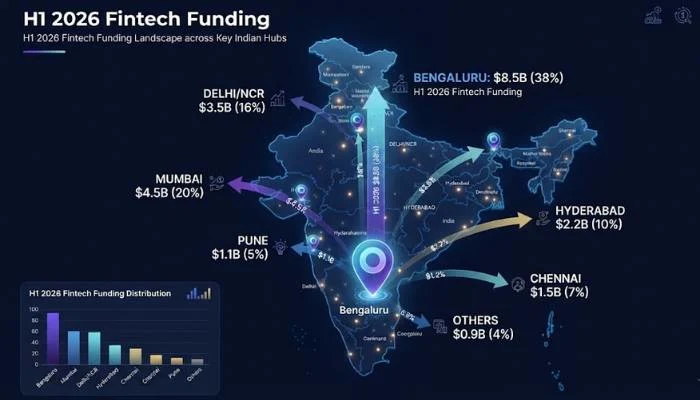
Bengaluru pulled far ahead of other cities in H1 2026. Startups based there raised $1.4 billion, accounting for 70% of all fintech funding . Mumbai was a distant second with $334 million, followed by Gurugram at $184 million . Hyderabad, Noida, Pune, Chennai, Delhi, Thane, and Ahmedabad together accounted for just 4% of the total capital .
This concentration of funding reflects the concentration of mature fintech companies in Bengaluru. It also shows that investors are not spreading their bets across geographies.
What This Means for the Future?
The fintech funding environment in India is becoming more selective. It is favouring scale, compliance, and profitability over hype and growth at any cost. This is creating a "survival-of-the-largest" phase for the sector .
This is not necessarily a bad thing. It will likely create a more sustainable fintech ecosystem by filtering out weaker business models. But the sharp decline in early-stage funding raises concerns about the innovation pipeline. Fewer funded startups today could mean fewer mature companies tomorrow.
The IPO market is also opening up. KreditBee is preparing to go public. CRED is also eyeing an IPO . Two fintech IPOs happened in H1 2026 after none in the year-ago period . Acquisitions, however, remain muted .
The Bottom Line
Fintech startup funding in 2026 shows a sector in transition. The money is there. $2 billion in six months is not a small number. But it is flowing to fewer companies. Established players are getting bigger cheques. Early-stage startups are struggling.
This is the new normal. Investors want mature companies with strong compliance and clear profitability. The days of easy money are gone. For early-stage founders, the message is clear: build real revenue, show capital efficiency, and demonstrate a clear path to scale. The funding is there for companies that can prove they are ready for it.
FAQs
1. How much did fintechs raise in early 2026?
$2 billion in the first half. Up 42% from last year. But only 106 companies got money. Earlier it was 186. Big firms took most of it. Small startups saw their funding drop a lot.
2. Which fintech companies became unicorns?
KreditBee hit $1.5 billion in April. Juspay reached $1.2 billion in January. Unicorn means a private firm worth over $1 billion. CRED is now at $4.5 billion after its latest round.
3. Why are small fintechs struggling to raise funds?
Investors want safer bets now. They look for revenue and profits. RBI rules on lending got tougher. Seed funding fell 42% to $68.6 million. Early-stage funding dropped 43% to $367 million. Easy money is not there anymore.
4. Which city got the most funding?
Bengaluru. $1.4 billion in H1 2026. That is 70% of all fintech money. Mumbai got $334 million. Gurugram got $184 million. Bengaluru has the most mature fintech firms.
5. What should new founders do now?
Build real revenue. Show you can grow without burning cash. Investors want proof, not just ideas. Money is there for firms that are ready. Raising funds without a solid plan is much harder now.