
Raising seed funding feels like a mountain to climb. You have an idea. You have a small team. But you do not have revenue yet. Investors want proof. Banks want collateral. It feels like a catch-22.
This guide explains how to raise seed funding for a startup in simple words. You will learn the different avenues. You will see how to get funding from the government. You will also understand what investors actually look for. No complicated jargon. Just clear steps that work. Read this guide Know your options. Start building the business investors want to fund.
What Is Seed Funding?
Seed funding is the first real money your startup gets. It comes at the seedling stage. You might have an idea. You might have a prototype. You might have a few early users . This money helps you build your product, test the market, and get to the next stage.
The risk is high for investors. Most startups fail. So they do not give loans. They buy equity. They take a share of your company in exchange for cash . If you win, they win big.
Read More: Best Website Analytics Tools for Startups: A 2026 Guide
How to Get Funding for Startup from Government

The Indian government has several schemes for early-stage startups. The biggest one is the Startup India Seed Fund Scheme (SISFS).
Startup India Seed Fund Scheme (SISFS)
This scheme has a corpus of 945 crore. It gives money to DPIIT-recognized startups through selected incubators .
How much you can get:
- Up to 20 lakh as a grant for proof of concept, prototype development, or product trials .
- Up to 50 lakh as debt or convertible debentures for market entry and commercialization .
Who can apply:
- Your startup must be DPIIT-recognized.
- It must be incorporated within the last 2 years.
- You must use technology in your product or business model.
- You should not have received more than 10 lakh from other government schemes .
- Indian promoters must hold at least 51% .
How to apply:
You apply through the official portal. You choose an incubator. The incubator reviews your application. If selected, you may need to pitch. Funds come in stages based on milestones .
Other government schemes include NIDHI PRAYAS, BIRAC schemes, and TIDE 2.0 . These are smaller but worth exploring.
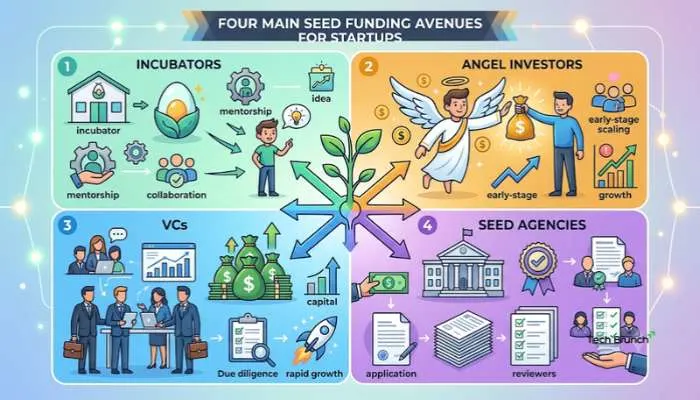
How to Raise Seed Funding for a Startup: The Avenues
You have four main places to look for seed money.
1. Incubators and Accelerators
These are institutions that support early startups. They give you office space, mentorship, and sometimes money. They help you build your product and find customers . Many government schemes route their funding through these incubators.
2. Angel Investors
These are wealthy individuals. They invest their own money. They are usually the first investors in a startup. They take higher risk but want a stake in your company. They often demand control and have smaller ticket sizes compared to VCs .
3. Venture Capital (VC) Funds
VCs manage pooled money from investors. They look for startups that can scale huge. They want a big market and a strong team. At the seed stage, some VCs are active. Others wait for Series A .
Active early-stage VCs in India include Blume Ventures, Kae Capital, 3one4 Capital, and First Cheque . They write cheques from 25 lakh to a few crores.
4. Seed Funding Agency
Some firms specialize in seed funding. They act like a bridge between founders and capital. AUM Ventures is one example. It launched a 750 crore fund for deeptech and IP-led startups. It writes initial cheques of $750K to $2M at the pre-seed and seed stage . ConsumerX Ventures is another. It launched a 150 crore fund for consumer brands at the zero-to-one stage .
You May Also Read: AI Tools for Startup Marketing That Actually Work in 2026
Pre Seed Funding for Startups
Pre-seed is even earlier than seed. You might just have an idea. Or a very early prototype. The amounts are smaller. The risk is higher.
Some VCs focus only on pre-seed. First Cheque writes cheques of 25 lakh to 1 crore. Titan Capital does 20 lakh to 3 crore. Better Capital does 40 lakh to 2 crore . These are for founders who are just starting out.
What Investors Want to See?
You need more than a good idea. Here is what actually matters.
- Proof of concept. You do not need revenue. But you need something. A working product. Early users. A waitlist that actually engages. If you are still figuring out what to build, you are not ready .
- A clear "why now." What changed in the last 12-24 months that makes your startup possible? New technology? New regulation? If the answer is nothing, investors will pass .
- A realistic plan. Know how much you need. Calculate 18-24 months of expenses. Add 25% for surprises. That is your number. Do not inflate it. Do not deflate it .
- Willingness to dilute. Seed rounds usually take 10-20% of your company. If you are not ready to give up equity, you are not ready to raise .
Quick Summary Table
| Avenue | What It Is | Typical Amount |
|---|---|---|
| SISFS (Government) | Grant + debt via incubators | 20L grant + 50L debt |
| Angel Investors | Wealthy individuals | Small cheques, varies |
| VC Funds | Pooled investment firms | 25L to a few crores |
| Seed Funding Agency | Specialized early-stage funds | $750K to $2M |
| Incubators | Support + sometimes funding | Varies |
FAQs
1. What is seed funding in simple words?
Seed funding is the first money a startup raises from outside investors. It helps you build your product and find your first customers. You give up a small piece of your company in return .
2. How can I get government funding for my startup?
Apply for the Startup India Seed Fund Scheme. You need DPIIT recognition and must be incorporated within 2 years. You can get up to 20 lakh as a grant and 50 lakh as debt through selected incubators .
3. What is pre-seed funding?
Pre-seed is the earliest stage. You might have just an idea or a prototype. Cheques are smaller. Some VCs like First Cheque and Titan Capital focus on this stage .
4. What is aseed funding agency?
It is a specialized fund that invests at the seed stage. Examples include AUM Ventures for deeptech and ConsumerX for consumer brands. They provide the first institutional cheque .
5. How much equity should I give away at seed?
Most seed rounds take 10-20% of your company. Be prepared to dilute. If you are not comfortable, bootstrap longer or find smaller angel cheques .
6. Do I need revenue to raise seed funding?
No. But you need proof of concept. A working product, early users, or a strong waitlist. Investors need something to evaluate. A pure idea is hard to fund .
7. How long does it take to raise a seed round?
It can take 3-6 months. Start talking to investors when you have 6-9 months of runway left. Do not wait until you are desperate .
8. What is the best way to start?
Start with government schemes if you qualify. They are non-dilutive or low-dilutive. Then talk to angels and seed VCs. Build your pitch deck. Show traction. Be honest about what you need.