
Enterprise AI has moved past the experimental phase. Companies are no longer asking whether they should use AI. They are asking which tools will actually deliver results. The market is crowded, and choosing the wrong one wastes time and money. This guide covers the best enterprise AI tools for business in 2026. Microsoft 365 Copilot leads for Microsoft shops. ChatGPT Business offers the most versatility. Salesforce Agentforce powers CRM workflows. Zapier Agents enables no-code automation.
We also cover free and open-source options for smaller organizations. Each tool is broken down by what it does, who it is for, and what it costs. No fluff. Just clear recommendations to help you choose the right platform for your business.
What Are Enterprise AI Tools?
Enterprise AI tools are software platforms that bring artificial intelligence into business workflows. Unlike consumer AI apps, these tools focus on security, governance, integration, and scale. They connect to your existing systems, respect your data permissions, and provide controls for IT administrators .
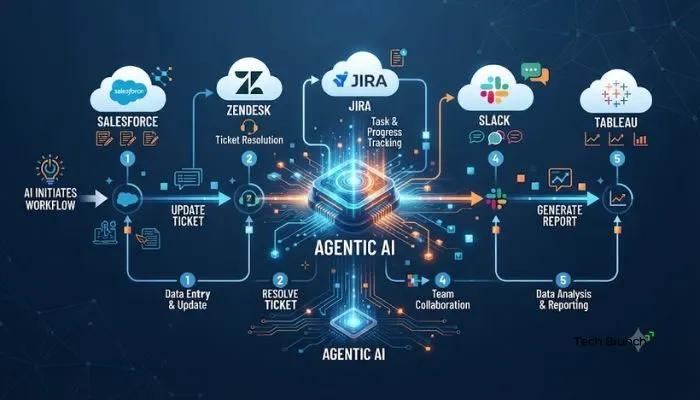
The shift in 2026 is toward agentic AI. These are systems that do not just answer questions. They take actions. They can execute multi-step workflows, connect to different applications, and complete tasks with limited human input .
Read More: Enterprise Cloud Migration Strategy: 2026 Practical Guide
Best Enterprise AI Tools for Business
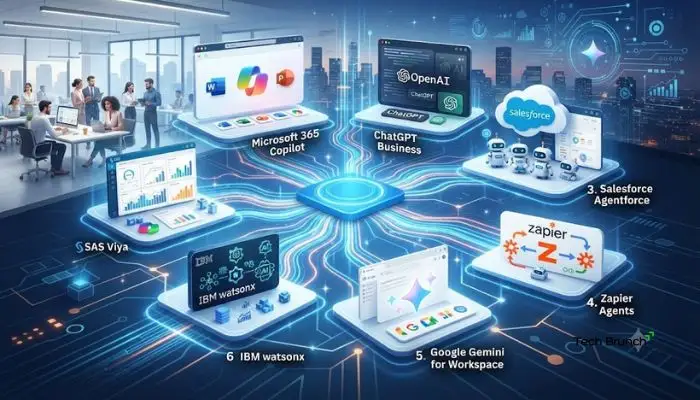
1. Microsoft 365 Copilot
Best for: Organizations already using Microsoft 365
Microsoft 365 Copilot brings AI into Word, Excel, PowerPoint, Outlook, and Teams. It uses your organization's work context while operating within existing security and compliance controls . It also includes specialized agents for research, analysis, and other workplace tasks.
Key features:
- Deep integration with Microsoft 365 apps
- Uses existing organizational context and permissions
- Works inside applications employees already use
- Specialized agents for research and analysis
Pricing: $21 per user/month (promotional price of $18 through September 30, 2026). Requires an eligible Microsoft 365 plan .
The catch: Less compelling outside a Microsoft-centered environment. Adds another per-user cost across large deployments .
2. ChatGPT Business
Best for: Versatile enterprise AI across multiple tasks
ChatGPT Business combines general-purpose AI with tools for research, writing, analysis, coding, and knowledge management. Employees use the same workspace for different types of tasks instead of adopting separate AI products .
Key features:
- Versatile AI workspace supporting multiple task types
- Enterprise knowledge connections
- SAML SSO, MFA, and centralized administration
- Business workspace data not used for training by default
Pricing: Standard at $20/user/month (annual billing) or $25/month. Premium at $100/user/month (annual) or $125/month. Enterprise pricing is custom. Requires at least two paid licenses .
The catch: Factual outputs should always be verified when accuracy is critical. Less deeply integrated into specialized CRM and service workflows .
3. Salesforce Agentforce
Best for: CRM-driven AI agents
Salesforce Agentforce brings AI agents into workflows built around Salesforce CRM data. Customer-facing and employee-facing agents can use business information and configured processes to answer questions and take permitted actions .
Key features:
- CRM-connected agents using Salesforce data
- Agent-building tools for prompts, jobs, and actions
- Integration with existing Salesforce workflows and APIs
- Consumption monitoring through Digital Wallet
Pricing: Varies by model. Salesforce Foundations is $0 add-on for eligible Enterprise Edition customers. Flex Credits at $500 per 100,000 credits. Conversations at $2 per conversation .
The catch: Best fit for organizations already invested in Salesforce. Advanced configurations can require specialist expertise .
4. Zapier Agents
Best for: No-code cross-app AI automation
Zapier Agents focus on AI that can perform work across connected applications. Agents use business information, access the web, and carry out configured actions without forcing everything into one vendor ecosystem .
Key features:
- Cross-app agents across Zapier's integration ecosystem
- Live business data access
- No-code configuration
- Web access for workflows requiring external information
Pricing: Free plan with up to 400 activities per month. Pro at $400/year (about $33.33/month) with up to 1,500 activities per month .
The catch: Activity usage can raise costs as automation expands. Complex agents require careful permissions and instructions .
5. Google Gemini for Workspace
Best for: Teams using Google Workspace
Gemini integrates directly into Google Docs, Sheets, Gmail, and Drive. It drafts, rewrites, and refines content. It summarizes conversations and drafts replies. It provides natural language search across Google Drive .
Key features:
- Writing assistance in Google Docs
- Data summaries and explanations in Sheets
- Email drafting and summarization in Gmail
- Contextual search across Google Drive
Pricing: Included in Google Workspace plans.
6. ServiceNow AI
Best for: IT and enterprise service operations
ServiceNow AI applies artificial intelligence to incidents, requests, and operational workflows. It focuses on stability, predictability, and governance. It fits organizations with complex service environments .
Key features:
- Incident prediction and anomaly detection
- Automated ticket classification and routing
- Workflow automation for service delivery
- Service performance insights
7. IBM watsonx
Best for: Regulated industries needing governance
IBM watsonx is designed for enterprises building and managing AI systems at scale. It focuses on model development, governance, and lifecycle management. Trust, transparency, and compliance are core priorities .
Key features:
- Model training and deployment tools
- AI governance and risk management
- Explainability and transparency capabilities
- Hybrid and multi-cloud support
8. SAS Viya
Best for: Analytics-driven enterprises
SAS Viya provides governed AI assistants and agentic AI capabilities. The platform includes SAS Viya Copilot, which helps users analyze data, build models, and make decisions while maintaining enterprise-grade security .
Key features:
- SAS Viya Copilot for data and AI tasks
- Model Context Protocol Server for agent integration
- Agentic AI Accelerator for building and deploying agents
- Industry-specific copilots for finance, health, and more
Enterprise AI Tools for Business List: Quick Comparison
| Tool | Best For | Starting Price |
|---|---|---|
| Microsoft 365 Copilot | Microsoft environments | $21/user/month |
| ChatGPT Business | Versatile tasks | $20/user/month |
| Salesforce Agentforce | CRM workflows | Varies by model |
| Zapier Agents | Cross-app automation | Free tier available |
| Google Gemini | Google Workspace | Included in plans |
| ServiceNow AI | IT service management | Custom pricing |
| IBM watsonx | Regulated industries | Custom pricing |
| SAS Viya | Analytics enterprises | Custom pricing |
Free Enterprise AI Tools
Not every useful AI tool requires a big budget. Several free and open-source options exist for businesses.
- The AI Shift repository is a collection of free, open-source AI tools built for real business problems. It includes tools for marketing, ecommerce, recruitment, education, healthcare, and finance. Examples include a LinkedIn Newsletter Generator and a Financial Report Summariser. Most tools run in under five minutes with a free Claude API key .
- Rebel by Mindstone is free for individuals and organizations with up to 100 users. It connects to existing workplace tools and gives each employee a personal AI agent linked to shared organizational memory. At Epignosis, a 250-person company, the system delivered the equivalent of eight full-time roles after 12 weeks .
- ToqanClaw by Naspers and Prosus is completely free for South African businesses. It uses multiple AI models and allows entrepreneurs to create apps and automations through descriptive prompts. No coding required .
- Gnani.ai's Artha is an India-based enterprise AI stack. It combines a 30-billion-parameter multilingual model with an agent platform. It is designed as an alternative to foreign AI infrastructure for Indian enterprises and government organizations .
- Sarvam AI's Epoch Builder Edition provides access to base models, training infrastructure, datasets, and deployment tools for Indian languages and use cases. It is available in private preview from August 2026 .
You May Also Read: Enterprise AI Productivity Trends 2026: Top 10 Insights
How to Choose the Right Enterprise AI Tool?
- Start with your existing stack. If you run on Microsoft, Copilot is the natural choice. If you use Google Workspace, Gemini is already there. If you live in Salesforce, Agentforce makes sense.
- Match the tool to the task. General-purpose AI like ChatGPT works across many tasks. Specialized tools like ServiceNow AI or Salesforce Agentforce work better for specific workflows.
- Consider governance needs. Regulated industries should prioritize tools with strong governance features. IBM watsonx and SAS Viya are built for this.
- Test before you commit. Most enterprise AI tools offer trials or free tiers. Start small, measure results, and scale what works.
The Bottom Line
Enterprise AI tools for business have matured. The question is no longer whether to adopt AI. It is which tools will deliver real value. Microsoft 365 Copilot leads for Microsoft shops. ChatGPT Business offers the most versatility. Salesforce Agentforce powers CRM workflows. Zapier Agents enables no-code automation across apps.
Free and open-source options are also viable for smaller organizations or those testing the waters. Start with what fits your existing stack. Test with real workflows. Measure results. Scale what works. The right tool depends on your specific needs, not marketing claims.
FAQs
1. What are enterprise AI tools?
Enterprise AI tools are software platforms that bring artificial intelligence into business workflows. They focus on security, governance, integration, and scale. They connect to existing systems and provide controls for IT administrators.
2. What is the best enterprise AI tool for business?
It depends on your setup. Microsoft 365 Copilot is best for Microsoft environments. ChatGPT Business is the most versatile. Salesforce Agentforce is best for CRM workflows. Zapier Agents is best for cross-app automation. Choose based on your existing stack and needs.
3. Are there free enterprise AI tools?
Yes. The AI Shift repository offers free open-source tools for marketing, ecommerce, and more. Rebel by Mindstone is free for up to 100 users. ToqanClaw is free for South African businesses. Gnani.ai's Artha and Sarvam AI's Epoch Builder serve Indian enterprises.
4. What is agentic AI in enterprise?
Agentic AI refers to systems that can independently understand context, execute multi-step workflows, and complete business tasks without continuous user intervention. They do not just answer questions. They take actions across applications.
5. What should I look for in an enterprise AI tool?
Integration with your existing systems. Security and compliance features. Governance controls. Pricing that fits your scale. A clear ROI path. Start with your current stack and choose the tool that fits.
6. Which enterprise AI tool has the best governance?
IBM watsonx and SAS Viya are built for regulated industries with strong governance, transparency, and compliance features. ServiceNow AI also emphasizes stability and predictability for enterprise service operations.
7. Can I use enterprise AI without a big budget?
Yes. Free and open-source options exist. Rebel by Mindstone is free for up to 100 users. The AI Shift repository offers free tools for real business problems. ToqanClaw is free for South African businesses. Start with free options to test value before committing budget.