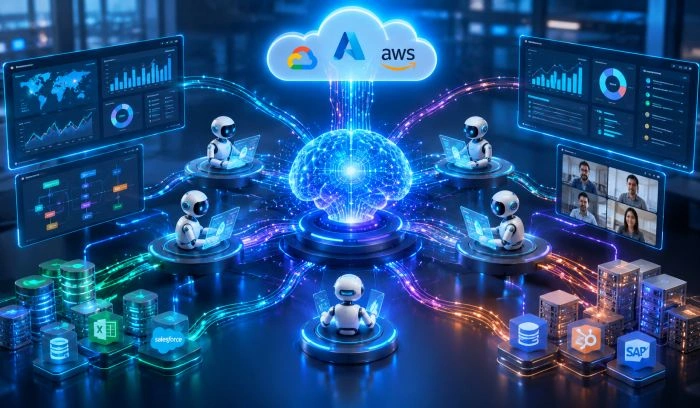
Enterprise AI automation is moving fast. The shift from simple chatbots to autonomous agents is happening now. Companies are using AI to execute multi-step workflows, not just answer questions. Enterprise AI automation tools for companies cover agent orchestration, testing, and governance.
Microsoft, Salesforce, and ServiceNow lead the market. Oracle, Databricks, and AWS top ISG's 2026 rankings. Real deployments at Tata Steel, CIBC, and Swiggy show this is not hype. Tata Steel runs 300+ agents. CIBC gave 50,000 employees agentic AI.
Swiggy connects to ChatGPT through MCP. Free tools exist too. n8n, Skyvern, and Small Tester handle testing and workflows without licensing costs. This guide covers the platforms, the free options, and what to watch.
What Enterprise AI Automation Looks Like in 2026?
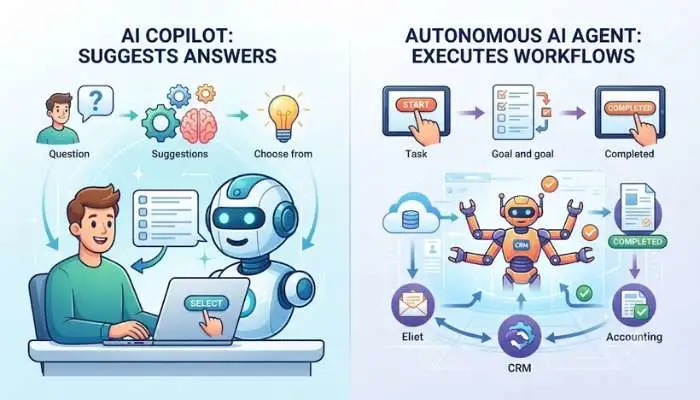
The market has shifted from "copilots" to "agents." A copilot suggests. An agent acts. It interprets intent, reaches into systems, and executes within defined limits . The leading vendors are competing to become the operational control plane for enterprise AI the layer that governs how agents safely do work at scale .
Three players have emerged as early leaders: Microsoft, Salesforce, and ServiceNow .
Read More: Enterprise Technology Trends: What Is Shaping Business in 2026
The Leading Enterprise AI Automation Platforms
Microsoft: The Universal Control Plane
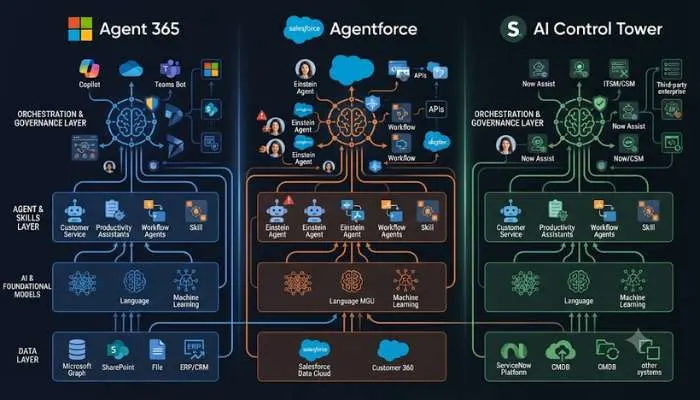
Microsoft is attempting to build a universal enterprise AI control plane. The stack combines Agent 365, Azure AI Foundry, Copilot Studio, Microsoft Graph, Fabric, and Entra ID .
This creates an orchestration fabric spanning productivity, data, workflow, and governance. Its embrace of interoperability standards like MCP and A2A strengthens its ecosystem leverage .
Salesforce: From CRM to Workflow Orchestration
Salesforce is extending beyond CRM into broader workflow orchestration through Agentforce, Data Cloud, and MuleSoft . Its API-first strategy positions it as one of the most commercially aggressive agentic AI vendors.
Agentforce ARR growth shows enterprises are willing to invest in platforms that embed autonomous execution into customer engagement and operational workflows .
ServiceNow: Governance-First Automation
ServiceNow differentiates through a governance-first model anchored in enterprise workflow reliability . Its AI Control Tower provides agent orchestration and governance. The company's acquisition of Armis for asset visibility and security posture integration demonstrates a deliberate effort to become the trusted operational nervous system for governed enterprise automation .
A real-world example: Leidos, a Fortune 500 national security company with 50,000 employees, is deploying the ServiceNow AI Platform to automate IT and HR workflows. Projected outcomes include $3M+ annual savings, up to 60% autonomous IT ticket resolution, and elimination of approximately 80,000 tickets annually .
Other Major Enterprise Players
- Oracle, Databricks, and AWS ranked as the top three overall leaders in ISG's 2026 Buyers Guide for AI Agents . The report evaluated 32 software providers across agent design, model orchestration, lifecycle management, and governance.
- Google was named a Leader in Gartner's 2026 Magic Quadrant for Enterprise AI Assistants. Gemini Enterprise unifies chat, search, first and third-party agents, a no-code agent designer, and Workspace integration in one platform .
- IBM, Google Cloud, and UiPath were also rated Exemplary by ISG, alongside Microsoft, Salesforce, and ServiceNow .
Real-World Enterprise Deployments
Tata Steel: 300+ Agents Across Operations
Tata Steel deployed more than 300 specialised AI agents in nine months across manufacturing, maintenance, finance, procurement, HR, and customer service . The digital assistant resolves over 70% of routine HR tickets autonomously. Customer complaint turnaround time was cut by 50% .
CIBC: Agentic AI for 50,000 Employees
CIBC launched CAI 2.0, the first enterprise-wide agentic AI workspace in Canadian banking. Team members can delegate complex, multi-step tasks to AI agents that plan, coordinate, and complete work . Examples include gathering research during client meetings, coordinating compliance work, and accelerating financial analysis from half a day to a quick review .
Swiggy and Indian Enterprises
Swiggy connected its platforms to AI assistants through the Model Context Protocol (MCP). Assistants can search, build carts, and place orders. Swiggy becomes the execution layer behind the AI interface . HDFC Bank is building a unified agentic platform with five use cases in production and 14 in development .
Free AI Tools for Automation Testing
For teams that need free options, especially for testing, several open-source tools stand out.
AI-Watch-Tester (AWT)
AWT is an open-source AI automation testing framework. It uses AI to generate test scenarios from URLs or spec documents, runs real browser tests via Playwright, and includes a self-healing DevQA loop . It works with OpenAI, Anthropic, or Ollama (free local models). Available as a cloud tool, local CLI, or MCP server .
Shortest
Shortest creates Playwright-based end-to-end tests from natural-language definitions. It is open-source and lets you express browser-test intent in plain English while using Playwright for execution .
Skyvern
Skyvern automates browser workflows using language models and computer vision. It handles dynamic, visually complex web workflows without maintaining long XPath or selector chains. Free open-source edition available .
Stagehand
Stagehand combines deterministic browser actions with natural-language automation. Developers can use explicit Playwright code for stable steps and AI-assisted operations for changing elements .
Small Tester
Small Tester is a free Chrome extension for no-code AI test automation. You describe test cases in natural language, and the AI runs them. It requires a free Google Gemini API key from Google AI Studio .
You May Also Read: Enterprise AI Tools for Business: Complete 2026 Guide
Free AI Automation Tools for Workflows
n8n
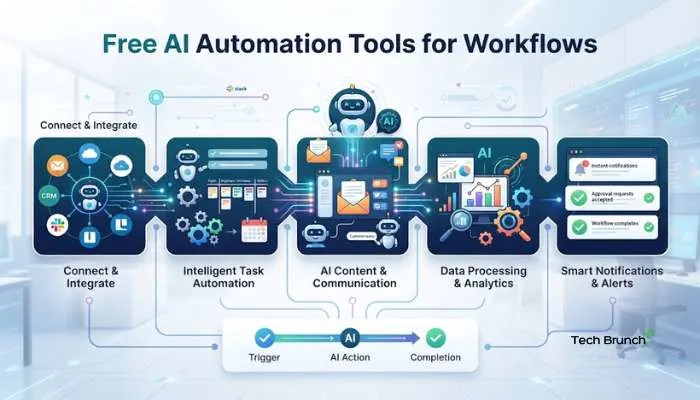
n8n is a visual, fair-code workflow builder with 400+ integrations and inline code nodes. It is self-hostable and free to start. It is the default self-hosted Zapier alternative .
Activepieces
Activepieces is an MIT-licensed, AI-first no-code automation platform. It has a clean "pieces" model for publishing reusable integrations .
Dify and Flowise
Dify is a production LLM app platform with RAG pipelines, agents, and workflows on a visual canvas. Flowise is a drag-and-drop builder for LLM chains and agents .
browser-use
browser-use makes any website usable by an AI agent. It is currently the most-starred AI browser-automation project on GitHub.
The Bottom Line
Enterprise AI automation in 2026 is about agents, not assistants. Microsoft, Salesforce, and ServiceNow are building the operational control planes. Oracle, Databricks, and AWS lead in platform capabilities. Real deployments at Tata Steel, CIBC, and Swiggy show the technology is moving from pilot to production.
Free and open-source tools exist for testing and workflow automation. They cover everything from AI-generated test scenarios to browser agents and visual workflow builders. Start with the free options to test value. Scale what works. The shift to autonomous execution is happening now.
FAQs
1. What are enterprise AI automation tools?
They are platforms that use AI agents to execute business workflows autonomously. Unlike chatbots that answer questions, these tools plan, reason, and take action across enterprise systems within defined governance limits .
2. Who leads the enterprise AI automation market?
Microsoft, Salesforce, and ServiceNow are early leaders, according to the Futurum Group. Oracle, Databricks, and AWS topped ISG's 2026 Buyers Guide. Google was named a Leader in Gartner's 2026 Magic Quadrant for Enterprise AI Assistants .
3. What are free AI tools for automation testing?
AI-Watch-Tester, Shortest, Skyvern, Stagehand, and Small Tester are free or open-source options. They use AI to generate tests, handle dynamic web elements, and self-heal when pages change .
4. What is the difference between a copilot and an agent?
A copilot suggests actions. An agent executes them. Agents interpret intent, reach into systems, reason across multiple steps, and act within defined limits. The value shifts from assistance to operational intervention .
5. How is Tata Steel using AI agents?
Tata Steel deployed 300+ specialised agents across manufacturing, HR, finance, and customer service. The digital assistant resolves 70% of HR tickets autonomously. Customer complaint turnaround dropped by 50% .
6. What is MCP?
Model Context Protocol is an open standard for connecting AI assistants to external tools and data. Swiggy uses MCP to let ChatGPT, Claude, and Gemini interact with its platform. Microsoft and Google embrace MCP for interoperability .
7. What free workflow automation tools are available?
n8n, Activepieces, Dify, Flowise, and browser-use are free and open-source. They handle visual workflows, AI agents, and browser automation without licensing costs .
8. What is the biggest risk with enterprise AI agents?
Autonomy changes the risk equation. A chatbot that gives a wrong answer is a quality problem. An agent that gives a wrong answer and acts on it is an incident. Governance questions—what agents can do, which systems they can touch, and who authorized them—become critical .