Generative AI is moving fast. Over the past two years, it has gone from a novelty to a core business tool. Companies are now using it to solve real problems, cut costs, and improve productivity.
This article covers practical examples of generative AI for enterprise applications. We look at how companies are using it, the tools they choose, and the results they are seeing.
What Is Enterprise Generative AI?
Enterprise generative AI means using large language models and other AI tools for business purposes. It is not about making memes or writing poems. It is about helping employees work faster, making decisions better, and automating complex workflows.
Companies are using generative AI across many functions: sales, customer service, legal, software development, and operations. The key difference between consumer and enterprise AI is security, governance, and integration with existing systems .
Read More: Enterprise AI Productivity Trends 2026: Top 10 Insights
Real-World Examples of Enterprise Gen AI Use
Cisco: An Internal AI Assistant That Saves Hours
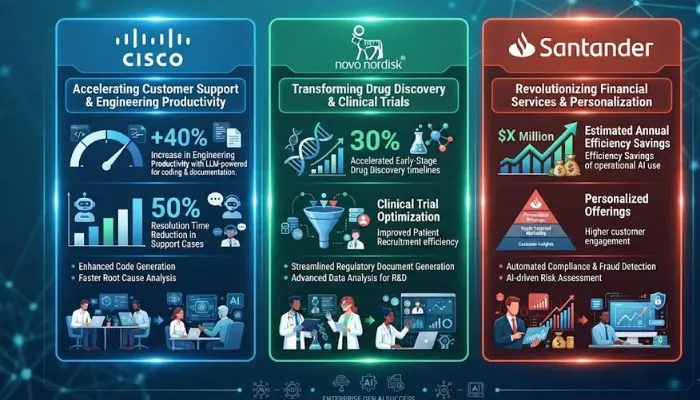
Cisco built an in-house AI assistant for its employees. The tool started in late 2023 when leadership decided not to block consumer AI tools like ChatGPT. Instead, they gave employees a secure alternative.
The assistant saves engineers an average of six hours per week and other employees about five hours . It helps with coding, HR tasks like scheduling vacation, and retrieving information from internal documents. More than 96,000 employees use it, with 90% adoption .
The cost is about $10 per user per month, which is lower than many off-the-shelf options . The company plans to add personalized agents that can take actions on behalf of employees, like sorting emails by priority .
Novo Nordisk: 2,500 Chatbots Built by Employees
Pharmaceutical company Novo Nordisk took a different approach. They built a self-service platform where employees can create their own chatbots. More than 25,000 employees have used it to build over 2,500 chatbots for various use cases .
Employees use the platform for tasks like retrieving information from documents, drafting documents with correct formatting, or acting as a virtual colleague. The average cost per chatbot is about $10 per month using serverless services . One employee reported completing work that previously took a day in just 30 minutes .
The company wanted to democratize innovation. Instead of trying to predict which use cases would work, they gave employees the tools to experiment safely .
Santander: Automating Legal Work with 98.7% Accuracy
Santander's legal team in Brazil was drowning in paperwork. They processed over 1,000 legal cases each month, with up to 200 pages of unstructured documents per case .
They used Pega GenAI to train a legal-specific model that could read and understand these documents. The results were dramatic. Accuracy jumped from 75% to 98.7%. Over 200,000 cases were automated. More than 2 million pages of legal documents were processed by AI. SLA compliance reached 99.5% .
The key was not replacing lawyers but giving them superpowers. Lawyers still reviewed final responses, but the AI did the heavy lifting .
Pega GenAI: Sales Assistance and Scenario Training
Pega offers generative AI features within its sales automation platform. The Sales Assistant analyzes recent activities like meetings and emails to assess engagement with decision-makers. It flags missed follow-ups and recommends immediate actions .
The assistant can answer questions like: "What is the most strategic move to close this deal?" or "What potential risks could affect this deal?" .
Pega also offers a Sales Simulator, which lets sales representatives practice conversations with AI-simulated customers. This helps them prepare for meetings and handle different customer personalities .
Enterprise Gen AI Tools: A Comparison
Several major platforms dominate enterprise generative AI deployment .
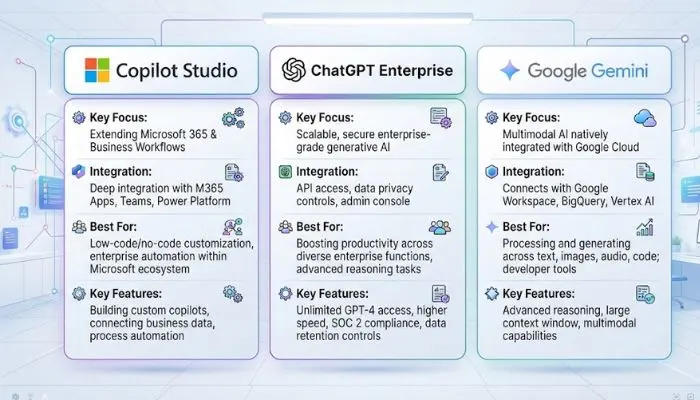
| Feature | Microsoft Copilot Studio | ChatGPT Enterprise | Google Gemini |
|---|---|---|---|
| Best for | Microsoft 365 shops | Research and experimentation | Google Workspace shops |
| Pricing | $200/tenant/month | $40-60/user/month | Included in Workspace plans |
| Integration | Native to Microsoft stack | Limited | Native to Google stack |
| Security | DoD IL5, GCC High | SOC 2 Type 2 | SOC 2 aligned |
| Grounding | Graph + Dataverse | Limited | Workspace data |
Microsoft Copilot Studio is the only platform with DoD and GCC High authorization, making it the choice for federal and regulated industries . ChatGPT Enterprise offers the strongest raw model capabilities but lacks native Microsoft integration. Google Gemini is the natural choice for organizations using Google Workspace .
You May Also Read: Best Enterprise Cybersecurity Software for Businesses 2026
How to Choose the Right Tool?
No single AI model works best for every use case. A model that is good for summarizing internal documents may not work well for customer service automation or software development .
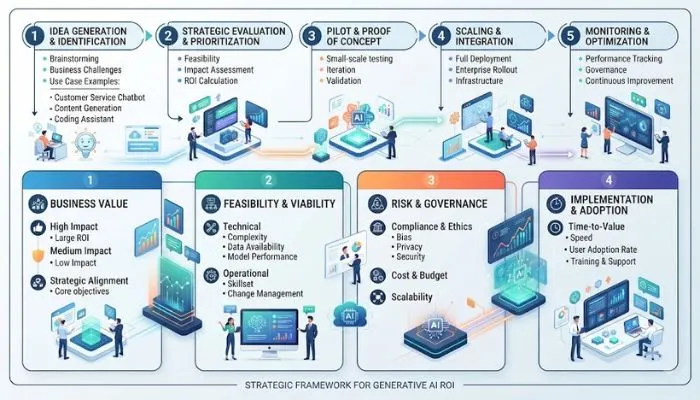
Here is how enterprise teams typically evaluate AI tools:
-
Writing and content creation: ChatGPT and Gemini work for general drafting. Claude is stronger for long-form documents. Llama offers customization options .
-
Coding and technical workflows: ChatGPT and Gemini provide general coding assistance. Claude handles complex implementation review. Llama works for custom deployments .
-
Research and analysis: ChatGPT and Gemini support research and summarization. Claude works with long documents. Llama offers more control for sensitive data .
-
Customer service and business workflows: Consistency, integration, and governance are more important than raw model performance .
The Bottom Line
Generative AI for enterprise applications is not hype. Companies are using it to save time, automate complex workflows, and improve accuracy. Cisco saves employees five to six hours per week. Novo Nordisk employees built 2,500 chatbots. Santander automated 200,000 legal cases with 98.7% accuracy.
The tools are maturing. Major platforms like Microsoft Copilot Studio, ChatGPT Enterprise, and Google Gemini offer secure, governed environments for deployment . The choice depends on your existing infrastructure, security requirements, and use cases .
The key is to start small, measure results, and scale what works. Companies that treat AI as a strategic capability, not just a tool, are pulling ahead.
FAQs
1. What are some real examples of generative AI in enterprise?
Cisco built an internal AI assistant for employees. It saves engineers six hours per week. Novo Nordisk lets employees build their own chatbots. Over 2,500 were created. Santander automated 200,000 legal cases with 98.7% accuracy using Pega GenAI.
2. What is the best generative AI tool for enterprises?
Depends on your setup. Microsoft Copilot Studio works best for Microsoft shops. It has DoD and GCC High authorization for regulated industries. ChatGPT Enterprise offers the strongest raw model. Google Gemini works well for Google Workspace users. Pick the one that fits your existing systems.
3. How much does enterprise generative AI cost?
Cisco pays about $10 per user per month for their internal assistant. ChatGPT Enterprise costs $40-60 per user per month. Microsoft Copilot Studio is $200 per tenant per month. Google Gemini is included in Workspace plans. Novo Nordisk pays about $10 per month per chatbot using serverless services.
4. What are Pega GenAI use cases?
Pega GenAI helps with sales and legal work. The Sales Assistant analyzes meetings and emails to flag missed follow-ups. It answers questions about closing deals or risks. The Sales Simulator lets reps practice conversations with AI customers. Santander used it to automate legal document processing.
5. How do I choose between AI models?
Match the model to the task. ChatGPT and Gemini work for general writing. Claude is better for long documents. Llama offers customization for specific needs. For coding, ChatGPT and Gemini provide general help. Claude handles complex reviews. For regulated industries, Microsoft Copilot Studio is the safest choice.