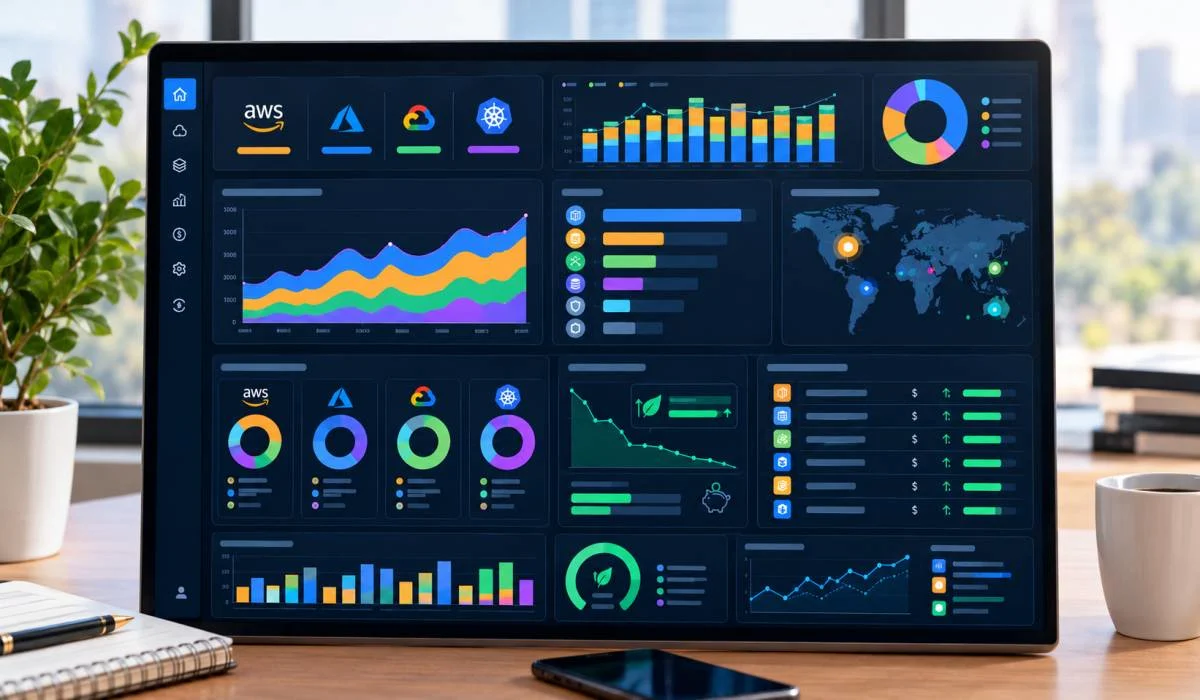
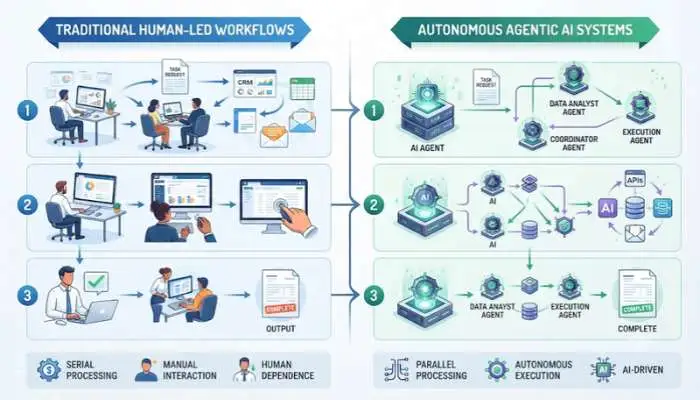
Enterprise technology is moving from a work support tool to enterprise systems doing the work. Companies had been purchasing applications to address a particular issue for decades. Individuals were making the links in the spreadsheet, sitting around the table. That era is ending. AI, particularly agentic AI, is becoming a key focus in the stack. Can receive a goal and determine the route, systems and make actions along the way.
It is more than just ERP and CRM. It covers AI platforms, observability solutions and agentic workflows. In this article, learn how it is defined, some examples of it, some companies creating it, and some solutions that will help define enterprise technology in 2026. No jargon. What is changing and why it is important.
What Is Enterprise Technology?
Enterprise technology is the software, hardware, and infrastructure that large organizations use to run their operations. It is different from consumer tech. It must handle thousands of users, strict compliance rules, complex integrations, and high reliability requirements.
Historically, enterprise tech was about control and standardization. Companies bought applications like ERP, CRM, and supply chain systems. These tools codified processes and created common records . The value came from making work predictable and scalable.
That definition is expanding. The new question is not just "what should we buy?" but "what capabilities are worth owning?" . Technology is moving from supporting work to performing it. This means the technology problem is becoming an operating model problem .
Read More: Enterprise FinOps Tools for Cloud Spending: Top Platforms and Free Options
Enterprise Technology Examples
It covers a wide range of systems. Here are the main categories.
Systems of record. ERP (Enterprise Resource Planning) handles accounting, inventory, and HR. CRM (Customer Relationship Management) handles sales, marketing, and support. These systems hold the core data that runs the business .
Observability and security. Platforms like Datadog unify metrics, logs, and security signals into a single view. They use AI to help teams troubleshoot and secure applications faster . Data security platforms like Cohesity protect data across on-premises, cloud, and edge environments .
Service and workflow. Freshworks builds customer and employee experience software used by over 74,000 companies . ServiceNow provides workflow automation for IT operations and enterprise services.
AI and agentic platforms. Salesforce Agentforce brings autonomous agents into CRM workflows . Dataiku offers a universal AI platform for building and governing models and agents . Coder provides secure cloud development environments where AI agents and developers collaborate .
Data and infrastructure. CockroachDB runs in some of the world's largest enterprises across banking, retail, and technology . Digital Realty provides data center and colocation solutions across 300+ facilities globally .
Enterprise Technology Companies
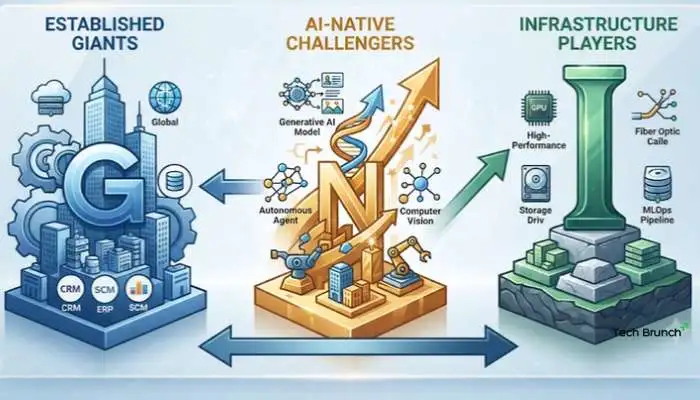
The enterprise technology market is dominated by both established giants and a new wave of AI-native companies.
- The giants. Microsoft, Salesforce, SAP, Oracle, and ServiceNow remain central. SAP is a Gold Partner for ERP transformation. Salesforce leads in agentic CRM. ServiceNow provides elite workflow automation .
- The AI-native challengers. Cursor has become a global transformation partner for AI-native software engineering. Nagarro is one of Cursor's six global partners, helping enterprises adopt intelligent development workflows . OpenAI partners with consultancies like Nagarro to accelerate enterprise-scale generative AI adoption .
- The infrastructure players. Cohesity serves over 12,000 enterprise customers, including 85 of the Fortune 100 . Datadog has 900+ integrations. Grafana Labs is trusted by 25 million+ users .
Enterprise Technology Solutions
The solutions landscape is being reshaped by four patterns .
Replace the automation layer. Retire RPA scripts and rules-based chatbots in favor of agentic workflows. This is the lowest-risk path, but it has the lowest ceiling. Nothing structural changes .
Build agents on top of systems of record. The cores stay intact and become the transactional substrate. Agents orchestrate above them. This is the most common enterprise choice. The risk is that business logic quietly leaks upward until you have two competing sources of truth .
Build alongside the systems of record. This is a more ambitious approach where the agentic layer coexists with existing systems, gradually taking on more responsibility.
Transform the core. The most disruptive path, where systems of record are rebuilt for an agentic world.
The pragmatic posture is to treat intent-driven design as directionally right but operationally immature. Scope narrowly. Constrain the action space. Keep humans on consequential decisions. Expand autonomy only where evidence supports it.
You May Also Read: Enterprise AI Automation Tools for Companies: 2026 Guide
The State of Enterprise Technology in 2026
AI adoption is widespread, but integration is hard. Gartner found that while 98% of technology leaders reported employees were keen to try generative AI tools, 72% had difficulty integrating them into daily work . Generative AI is expected to be embedded in more than 80% of independent software vendor enterprise applications by 2026, up from less than 5% in 2024 .
Security remains a top priority. Midsize enterprises are consolidating defenses around identity and endpoints. Zero trust network access is critical for hybrid work .
The architecture is still unsettled. There is no accepted answer to where business logic should live, how state should be partitioned between the agent and the core, or how to version a system whose behavior is emergent . Reference architectures are being published faster than they are validated in production.
The Bottom Line
Enterprise technology is at an inflection point. The old model of buying applications and connecting them with people is giving way to agentic systems that reason and act. This creates architectural challenges that are not fully solved.
The winners will be the organizations most deliberate about what is worth owning. They will start with the work, not the tool. They will build capabilities that compound through reuse. And they will expand autonomy only where evidence supports it. The future will not belong to those who own the most technology. It will belong to those most deliberate about what they own .
FAQs
1. What is enterprise technology in simple words?
It is the software and systems large organizations use to run their operations. Think ERP for accounting, CRM for sales, and security tools for protection. It must handle thousands of users, strict rules, and high reliability.
2. What is agentic AI in enterprise technology?
It is AI that can accept a goal and work out the path. Instead of performing one bounded operation, it reasons across systems, calls tools, and takes actions. This moves business logic into an orchestration layer above the systems of record .
3. Why is enterprise technology changing now?
Because AI can now participate in the work itself, not just support it. Technology is moving from supporting work to performing it. This makes the technology problem an operating model problem .
4. What is the biggest challenge with agentic AI in enterprises?
Maturity. Design patterns are unsettled. Repeatability is weak. Reliability degrades with chain length. Architecture principles do not yet exist. Most production successes today are short-chain and heavily guardrailed .
5. What should enterprises do right now?
Scope narrowly. Constrain the action space. Keep humans on consequential decisions. Expand autonomy only where evidence supports it. Do not bet the operating model on maturity that has not arrived .
6. How is AI adoption progressing in enterprises?
Fast, but uneven. Generative AI is expected in over 80% of enterprise applications by 2026. But 72% of leaders say employees struggle to integrate tools into daily work . Adoption is not the same as value.