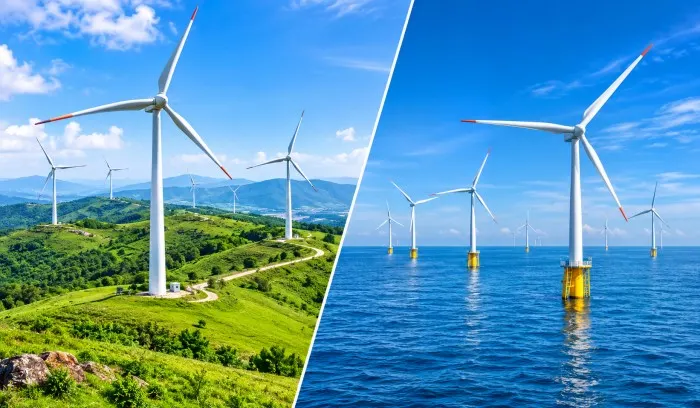
It's easy to decide between offshore wind and onshore wind on the surface level. Offshore will generate more power. Onshore costs less. A wind farm that is situated offshore has strong and constant winds that blow at sea. The turbines there operate at 50 percent or higher. Onshore wind is relatively low cost to construct and maintain.
However, there is less wind. It is at about 30 – 40% capacity. Special ships and undersea cables are needed offshore. Onshore requires land lines and grid both have a place both are growing. The only question is the location and the requirements. It's not a battle between offshore wind versus onshore wind. It is a balance.
Offshore vs Onshore Wind: The Basics
Onshore wind turbines stand on land. They are the ones you see in fields and on hills. They are common. They are cheap to build. They are easy to fix. The wind there is decent. But it is not great. It is bumpy. It slows down over trees and buildings.
Offshore wind turbines stand in the water. They are bigger. They are harder to build. But the wind out there is strong. It is steady. It does not stop. That makes a big difference.
The numbers tell the story. Offshore turbines run at 50 percent capacity or more. Some hit 56 percent. Onshore turbines run at 30 to 40 percent . That means an offshore turbine makes more power with the same size machine. It also means the power is more reliable.
Read More: How to Store Solar Energy at Home: Batteries, Costs and Storage Options
Onshore Wind Turbine: The Workhorse
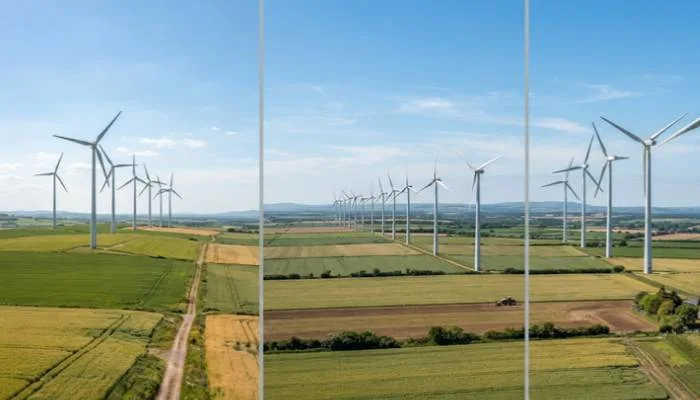
Onshore turbines are the backbone of wind power today. They are everywhere. Denmark gets a lot of power from them. The US Great Plains are full of them. India has big farms in Tamil Nadu and Gujarat.
The cost is the big win. Onshore wind costs about $50 per megawatt-hour . That is cheap. It beats coal, it beats gas in many places. It is one of the cheapest power sources we have.
The wind is weaker on land. It is around 5 to 8 meters per second . That is not bad but it is not great. Turbines need to be taller to reach better wind. They need to be spaced out and take up land.
Land use is a real issue. A big wind farm needs a lot of space. People do not always want them nearby. They are noisy. They are visible. Some people think they are ugly birds and bats can hit the blades. That is a real problem. It needs to be managed.
But onshore wind is easy to connect to the grid. The power lines are already there. Maintenance is simple you drive a truck to the turbine. You fix it that is not true offshore.
Offshore Wind: The Powerhouse
Offshore wind is the heavy hitter. The wind at sea is stronger. It is around 9 meters per second . It is also steadier. There are no hills. There are no trees. The wind flows smooth.
That means bigger turbines. Offshore turbines can hit 15 megawatts each . That is huge. One turbine can power thousands of homes. The Hywind Scotland floating farm hit 56 percent capacity . That is world class.
But the cost is high. Offshore wind costs about $80 per megawatt-hour . That is 60 percent more than onshore. Building in water is hard. You need special ships. You need strong foundations. You need undersea cables. Maintenance is a nightmare. You need boats and crews. You cannot just drive a truck.
The ocean is also a tough place. Salt water eats metal. Storms damage things. The marine environment is sensitive. Fish and sea mammals can be affected. The rules are complex. Many agencies are involved. Permits take years.
Offshore vs Onshore Wind Geography
Where you put a turbine matters. A lot.
On land, the wind is shaped by the land. Hills slow it down. Forests create turbulence. Buildings make it messy. The best onshore spots are flat and open. Plains. Coastal hills. Mountain gaps. That is where you find the big farms.
At sea, the wind is shaped by the water. The surface is smooth. There is less friction. The wind speeds up. A study in Japan found that a site just 1.5 km offshore had 12 percent higher annual wind speed than a nearby onshore site. The turbulence was 37 percent lower . That is a huge difference in a short distance. It shows why offshore is better.
The geography of the coast matters too. Some places have shallow water. That makes building easy. You can bolt the turbine to the seabed. Other places are deep. That needs floating turbines. Floating tech is newer. It is more expensive. But it opens up huge areas of ocean.
Onshore vs Offshore Winds Surfing
This is a different meaning of the same words. Surfers use "onshore" and "offshore" to describe wind direction at the beach. It has nothing to do with turbines. But the words are the same. So here is what they mean.
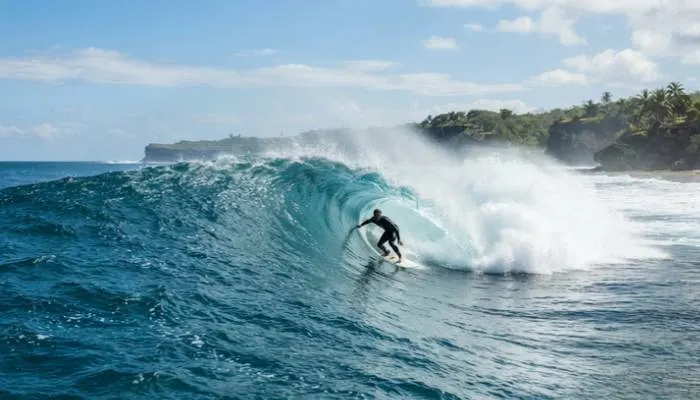
- Offshore wind blows from the land out to sea. That is good for surfing. It holds the wave face up. It makes the wave clean. It makes it hollow. It makes it fast . That is what surfers want.
- Onshore wind blows from the sea onto the land. That is bad for surfing. It crumbles the wave, It makes it messy and weak . The ride is shorter, the wave is not fun.
Cross-shore wind blows along the beach. It is in between. It can be okay. It depends on the spot.
So if you hear a surfer say "it is offshore today," they are happy. If they say "it is onshore," they are probably not going surfing.
You May Also Read: Latest Green Technology Innovations in 2026: Examples and Trends
Onshore Wind Direction: How to Read It
Wind direction is named for where it comes from. It blows south. That is simple.
But on a beach, it is about the shore. If your beach faces west, an east wind blows from the land to the sea. That is offshore. A west wind blows from the sea to the land. That is onshore .
This is why you need to know which way your beach faces. A wind that is offshore at one beach might be onshore at another. It depends on the coast.
Surf reports often tell you. They say "offshore" or "onshore" or "cross-shore." But not all do. If the report just gives a compass direction, you have to do the math yourself.
Onshore and Offshore Winds Diagram
Picture a beach. The sand is on the left. The water is on the right.
- An arrow pointing from left to right is onshore. The wind moves from land to sea. It is bad for surf.
- An arrow pointing from right to left is offshore. The wind moves from sea to land. It is good for surf.
- An arrow pointing up or down the page is cross-shore. It runs along the beach.
For turbines, the diagram is different. Onshore turbines are on the left. Offshore turbines are on the right. The wind blows across both. But the offshore wind is stronger. It is smoother. It makes more power.
The Bottom Line
- Offshore wind is better. It makes more power. It runs more often. It is the future for big projects. But it costs more. It is harder to build. It takes longer to permit.
- Onshore wind is cheaper. It is easier. It is proven. It is still growing fast. It will be a big part of the mix for a long time.
The smart play is both. Use onshore where the wind is good and the land is cheap. Use offshore where the wind is strong and the cities need power. They are not enemies. They are partners.
For surfers, remember: offshore is clean. Onshore is messy. That is the rule.
FAQs
1. Which is better, offshore or onshore wind?
Offshore makes more power. Stronger wind. Runs more often. But costs more. Onshore is cheaper. Easier to fix. Weaker wind. Need lots of power? Offshore. Need cheap power fast? Onshore. Both matter.
2. What is the main difference?
Location. Onshore sits on land. Offshore sits in water. Sea wind is strong and smooth. Land wind is weak and bumpy. Offshore needs ships. Onshore needs trucks. Same idea. Different setup.
3. Why is offshore wind more expensive?
Water is hard. Special ships. Strong foundations. Long cables. Salt eats metal. Storms break things. Fixing at sea takes boats. Fixing on land takes a truck. Offshore costs about $80 per megawatt-hour. Onshore costs about $50.
4. What does onshore and offshore mean for surfing?
Offshore wind blows from land to sea. Clean waves. Hollow. Fast. Surfers love it. Onshore wind blows from sea to land. Messy waves. Weak. Short ride. Surfers hate it. Simple.
5. Why does wind direction matter at the beach?
It tells you what the wind does. A north wind comes from the north. But at the beach, it is about the shore. Beach faces west? East wind is offshore. West wind is onshore. Same wind. Different beach. Different meaning.