
Seed funding is the first real money a startup raises. It comes after friends and family. Before venture capital. It helps you build a prototype. Find your first customers. Prove your idea works.
But how do startups get seed funding? It is not magic. It follows a pattern. You need something investors can look at. A working product. Early users. A waitlist that actually moves. You need to show why now is the right time.
In India, you have options. Angels. VC funds. Government schemes like SFS. This guide walks through the process. Step by step. No fluff.
What Is Seed Funding?
Seed funding is money for startups at the seedling stage. Your company might just have an idea. You might have a rough product. You probably do not have revenue yet .
Investors at this stage know the risk is high. But they also know the potential is huge. They invest through equity or convertible notes. Grants are also common, especially from government schemes .
Read More: Latest Tech Startup Acquisitions: Major AI Deals Reshaping 2026
When Should You Raise Seed Funding?
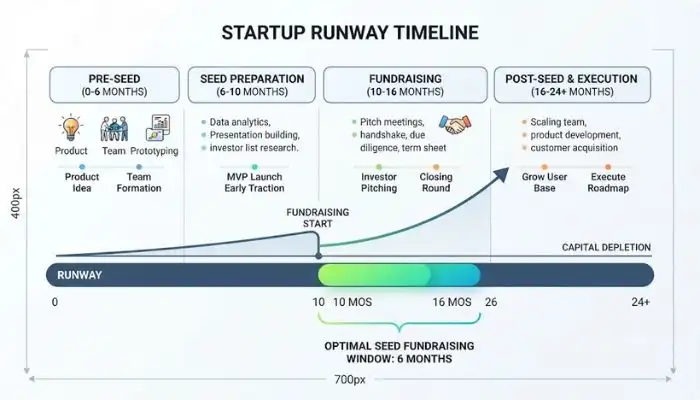
Timing matters more than you think. Raising too early wastes time. Raising too late creates desperation.
The right time to raise is when you have 6 to 9 months of runway left. When a key metric is growing month over month. When you just landed a customer or partnership .
The wrong time is when you are two months from running out of money. Desperation shows. Or right after launching with zero data .
Before you start pitching, ask three questions :
-
Do you have something investors can evaluate? A working product, early users, or strong waitlist engagement. No revenue needed, but proof of concept matters.
-
Why now? What changed in the last 12-24 months that makes your startup possible? If nothing changed, investors will not be convinced.
-
Are you ready to give up 15-25% of your company? Seed rounds typically dilute founders by this amount.
Where Seed Funding Comes From?
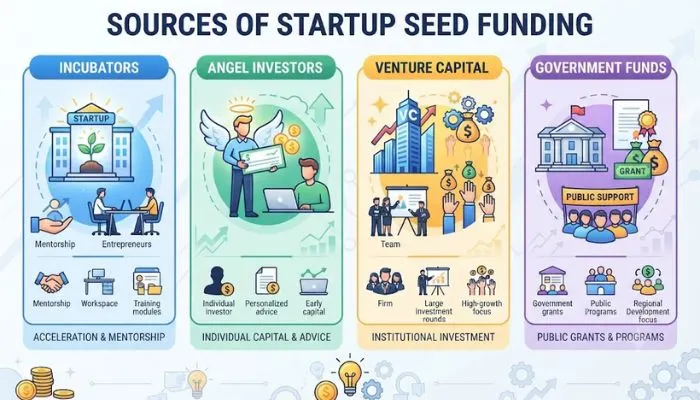
There are four main sources .
1. Incubators and Accelerators
These are institutions that support early startups. They provide infrastructure, mentorship, and sometimes funding. Government-supported or private, they help you develop your business .
The Startup India Seed Fund Scheme (SISFS) works through selected incubators. They approve grants or debt funding for proof of concept, prototype development, and market entry .
2. Angel Investors
Angels are wealthy individuals investing their own money. They are often the first outside investors. They demand higher control but write smaller cheques than VCs .
3. Venture Capital Funds
VC funds manage pools of money from institutions and wealthy individuals. They look for high-growth startups with large target markets. Most VCs focus on companies already in market, not pre-revenue ideas .
Some VCs do focus on seed stage. In India, firms like Kae Capital, Anicut Capital, and AUM Ventures back early-stage companies .
4. Government Funds
The Indian government offers several schemes for seed-stage startups. These are covered in detail below.
Government Funding Options in India
India has three flagship schemes under Startup India .
Startup India Seed Fund Scheme (SISFS)
- This is the most relevant scheme for seed funding. It provides up to Rs 20 lakh as grant or Rs 50 lakh as convertible debt through selected incubators .
- The scheme covers proof of concept, prototype development, product trials, market entry, and commercialization. Funds transfer directly to your startup's bank account in milestone-based instalments .
- To apply, you need to be a DPIIT-recognised startup. You select up to three approved incubators on the portal. The incubator's selection committee evaluates applications within 45 days .
- As of early 2026, 219 incubators are supported across India. Over 3,300 startups have been funded with Rs 592 crore approved .
Fund of Funds for Startups (FFS)
- This scheme does not invest directly. It provides capital to SEBI-registered Alternative Investment Funds (AIFs). Those AIFs then invest in startups .
- The corpus is Rs 10,000 crore. As of June 2025, commitments of Rs 9,994 crore were made to 141 AIFs. These AIFs have invested Rs 25,859 crore in 1,382 startups .
Credit Guarantee Scheme for Startups (CGSS)
This enables collateral-free loans through eligible financial institutions. The guarantee covers up to Rs 20 crore per case. As of mid-2025, 289 loans worth Rs 667.85 crore were guaranteed .
Other Government Schemes
Beyond the three flagship schemes, there are others :
-
NIDHI Seed Support System: Up to Rs 100 lakh per startup through eligible incubators. Low interest of 2-3% for debt financing .
-
TIDE 2.0: Promotes technology-based entrepreneurship through incubators.
-
BIRAC schemes: For biotech startups.
-
NIDHI PRAYAS: For hardware startups.
How the Process Actually Works?
Here is the real process from first email to bank transfer .
Step 1: Preparation (Months 1-2)
Build a target list of 50+ investors. Prepare your pitch deck, business plan, financial projections, and cap table.
Step 2: Outreach (Months 2-3)
Start conversations with investors 3-4 months before you need money. If they say "come back with more traction," you have time to build it. If they are interested, you can close quickly.
Step 3: Due Diligence
Investors will review your metrics, team, market, and financials. For government schemes, the incubator committee checks problem-solution fit, technology differentiation, commercial viability, scalability, and team strength .
Step 4: Legal and Disbursement
Once selected, a legal agreement is signed within 60 days. The first disbursement follows. Subsequent tranches are released upon milestone achievement. You must submit utilisation certificates before the next instalment .
You May Also Read: Startups Raising Seed Funding in 2026: Complete List and Guide
How Much Should You Raise?
Most seed rounds in India fall between $300K and $2M. The right amount depends on your stage :
-
$300K-$600K: Finishing your product and getting initial traction. Works for capital-efficient teams.
-
$600K-$1.2M: Building a small team, scaling from 10 to 100 customers, proving product-market fit.
-
$1.2M-$2M+: Larger rounds for expensive customer acquisition, longer sales cycles, or hardware/deep tech.
To calculate your number: list every expense for the next 18 months. Add 25% contingency. That is your target .
The Bottom Line
Seed funding is not magic. It is a process. You need something investors can evaluate. You need to show why now is the right time. You need to ask for enough to reach your next milestone with 18-24 months of runway.
In India, you have more options than most founders realise. Private VCs like Kae Capital and Anicut Capital back early-stage companies. Government schemes like SISFS provide grants and debt through incubators. The Fund of Funds channels capital to AIFs that invest in startups.
The key is preparation. Start conversations early. Know your numbers. Understand what each investor or scheme needs. Then execute.
FAQs
1. What is seed funding?
First real money a startup raises. After friends and family. Before VC. Helps you build. Test. Find customers.
2. When should I raise?
6 to 9 months of runway left. One metric growing. Just landed a customer. Do not wait until desperate. Start talking 3-4 months before you need cash.
3. Where does it come from?
Incubators. Angels. VC funds. Government schemes. Each has different cheque sizes and rules.
4. What is SFS?
Startup India Seed Fund Scheme. Government. Up to Rs 20 lakh grant. Or Rs 50 lakh convertible debt. Through selected incubators. Must be DPIIT-recognised.
5. How much should I raise?
$300K to $2M in India. Depends on stage. $300K-$600K for product. $600K-$1.2M for team. $1.2M+ for growth. Add 25% buffer.
6. How long does it take?
Prep 1-2 months. Outreach 2-3 months. Due diligence weeks. Legal 60 days. Start early.
7. What do investors want?
Something to evaluate. Product. Users. Traction. Why now. A team that executes.
8. What is Fund of Funds?
Government scheme. Gives money to AIFs. AIFs invest in startups. Rs 10,000 crore corpus. Rs 25,859 crore invested in 1,382 startups as of June 2025.