For decades, the United States has had a monopoly on positioning, navigation, and timing technology with its Global Positioning System (GPS), a constellation of satellites operated by the military that today provides the backbone for location on billion of devices worldwide.
As those technologies have become not just key to military maneuvers but the very foundation of modern economies, more and more governments around the world have sought ways to decouple from usage of the U.S.-centric system. Russia, Japan, India, the United Kingdom and the European Union have all made forays to build out alternatives to GPS, or at least, to augment the system with additional satellites for better coverage.
Few countries though have made the investment that China has made into its Beidou (北斗) GPS alternative. Over twenty years, the country has spent billions of dollars and launched nearly three dozen satellites to create a completely separate system for positioning. According to Chinese state media, nearly 70% of all Chinese handsets are capable of processing signals from Beidou satellites.
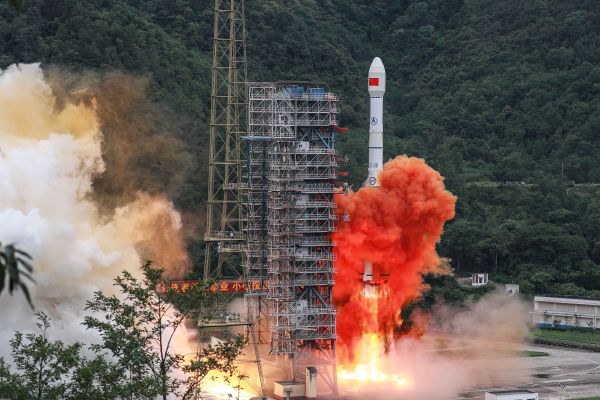
Now, the final puzzle piece is in place, as the last satellite in the Beidou constellation was launched Tuesday morning into orbit, according to the People’s Daily.
It’s just another note in the continuing decoupling of the United States and China, where relations have deteriorated over differences of market access and human rights. Trade talks between the two countries have reached a standstill, with one senior Trump administration advisor calling them off entirely. The announcement of a pause in new issuances of H-1B visas is also telling, as China is the source of the second largest number of petitions according to USCIS, the country’s immigration agency.
While the completion of the current plan for Beidou offers Beijing new flexibility and resiliency for this critical technology, ultimately, positioning technologies are mostly not adversarial — additional satellites can offer more redundancy to all users, and many of these technologies have the potential to coordinate with each other, offering more flexibility to handset manufacturers.
Nonetheless, GPS spoofing and general hacking of positioning technologies remains a serious threat. Earlier this year, the Trump administration published a new executive order that would force government agencies to develop more robust tools to ensure that GPS signals are protected from hacking.
Given how much of global logistics and our daily lives are controlled by these technologies, further international cooperation around protecting these vital assets seems necessary. Now that China has its own fully-working system, they have an incentive to protect their own infrastructure as much as the United States does to continue to provide GPS and positioning more broadly to the highest standards of reliability.