Funding and acquisition are not the same thing. People mix them up all the time. But they mean very different things in business. Funding is about getting money to run your company or make it bigger. Acquisition is about buying another company outright.
That is the main difference between funding and acquisition. The money for these big deals has to come from somewhere. Companies use cash sitting in the bank. They borrow from banks. Or they give the seller shares in their own company. Each choice changes the deal. Cash is clean but drains your reserves. Debt is cheap but risky. Stock saves cash but gives away ownership. The big question is always the same. How do you pay for it without breaking the company.
What is Funding?
Funding means raising capital. A company needs money to pay staff, build products, or expand. They get this money from different places.
There are two main types of funding:
- Debt financing means borrowing money. You take a loan from a bank or issue bonds. You pay it back with interest. The lender does not own part of your company. This is cheaper than equity because interest payments are tax-deductible. But you have to make fixed payments. If you cannot pay, you are in trouble.
- Equity financing means selling ownership. You give investors shares in your company. They give you cash. You do not have to pay them back. But they now own a piece of your business. They get a say in decisions. And they get paid before you do if the company does well.
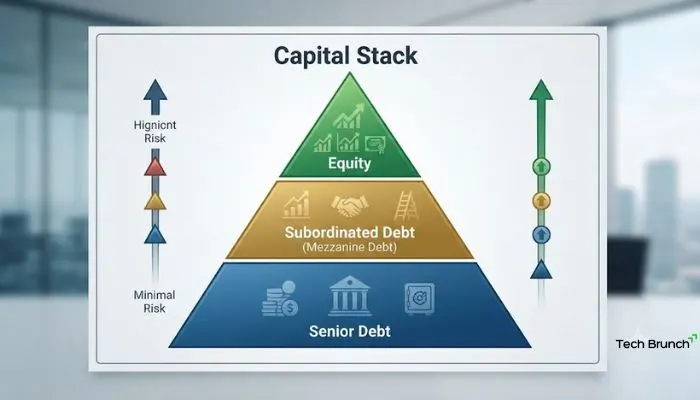
Companies often use a mix of both. This is called the capital stack. Senior debt is the safest and cheapest. Subordinated debt is riskier and more expensive. Equity is the most expensive but gives you flexibility.
Read More: Difference Between Private Equity vs Venture Capital Funding
What is an Acquisition?
An acquisition is when one company buys another. The buyer takes control of the target company. This can be friendly or hostile. The goal is usually to grow faster, enter new markets, or eliminate competition.
Acquisitions are expensive. So companies need a way to pay for them. This is where acquisition financing comes in.

How Do Companies Pay for Acquisitions?
Companies have three basic tools to pay for a deal: cash, stock, and debt. Most big deals use a mix of these.
- Cash is the simplest. The buyer pays with money from their bank account. This gives the seller certainty. The deal closes fast. But it drains the buyer's cash reserves. Broadcom buying VMware for $61 billion used cash and new debt.
- Stock means the buyer gives the seller shares in the combined company. No cash leaves the door. This works well when the buyer's stock price is high. But it dilutes existing shareholders. Your slice of the pie gets smaller. Disney used a mix of cash and stock for its $71 billion Fox deal.
- Debt means the buyer borrows money. They issue bonds or get a bank loan. This amplifies returns if the deal goes well. But it increases risk. The finance team runs stress tests to make sure they can afford the payments. Microsoft used cash and debt to buy Activision for $69 billion. Their AAA credit rating made borrowing cheap.
Advanced Financing Tools
Sometimes the basic tools are not enough. That is when companies use specialized structures.
- Leveraged Buyout (LBO) : The buyer uses a lot of debt to buy the target. The target's own assets and cash flow secure the loan. The debt goes on the target's books. This is common with private equity. Dell went private in 2013 for $24 billion using this structure.
- Bridge Financing : A short-term loan that covers the purchase price now. The company arranges permanent financing later. This is for deals that need to close fast.
- Syndicated Loans : Multiple banks team up to lend the money. One bank cannot handle the risk of a $69 billion deal alone. So they share it. Microsoft used this for the Activision deal.
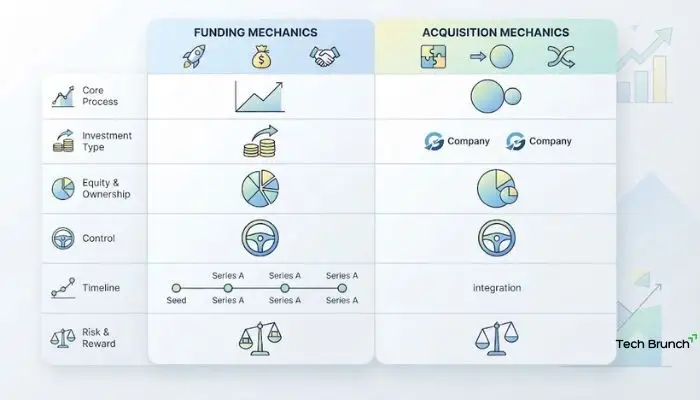
The Key Difference Summarize
| Feature | Funding | Acquisition |
|---|---|---|
| Purpose | Raise money to run or grow the business | Buy another company |
| Outcome | The company gets cash or a loan | The company gets control of another business |
| Methods | Debt, equity, or a mix | Cash, stock, debt, or a mix |
| Effect | Balance sheet changes | The target company is now owned by the buyer |
Real-World Examples
- Microsoft buying Activision Blizzard : This was a $69 billion acquisition. Microsoft used cash and debt. They did not use stock. Why? They had over $100 billion in cash. Their AAA rating made borrowing cheap. They wanted to avoid dilution.
- Amazon buying Whole Foods : This was a $13.7 billion deal. Amazon paid with cash. Interest rates were low. Amazon had strong cash flow. They wanted a physical store footprint fast.
- Disney buying 21st Century Fox : This was a $71 billion deal. Disney used cash and stock. They paid about $35 billion in cash and $36 billion in stock. They balanced the mix to protect their credit rating. But their net debt nearly tripled.
You May Also Read: Seed Funding vs Pre Seed Funding Differences: A Simple Indian Guide for Founders
What About India?
India is seeing more M&A activity. Deal volumes in the first half of 2025 grew 18%. But financing acquisitions in India has unique challenges.
Indian banks cannot usually finance equity acquisitions. This was a restriction from the RBI. But the RBI recently changed the rules. Banks can now fund up to 70% of the purchase price for listed companies. This could spawn a $20-30 billion LBO market in India.
Foreign Portfolio Investors (FPIs) are a popular source of debt. They can invest in listed and unlisted NCDs. This gives Indian companies more options.
Why Should You Care?
Understanding this difference helps you read business news better. When you see "Company X raises $100 million," that is funding. They are getting money to run their business. When you see "Company X buys Company Y for $10 billion," that is an acquisition. They are buying another business.
The financing mix tells you a lot about a company's strategy. Cash means confidence and speed. Stock means they want to save cash. Debt means they are betting on the future. Knowing this helps you understand the risks and opportunities.
FAQs
1. Is funding the same as getting a loan?
No. A loan is just one type of funding. Funding covers all ways a company gets money. This includes loans, selling shares, or even crowdfunding. A loan is debt. You pay it back with interest. Selling shares is equity. You give away ownership. Both are funding. But they work very differently.
2. Can a company use funding to buy another company?
Yes. That is exactly what happens in most acquisitions. A company raises funding through debt or equity. Then they use that money to buy the target. So funding is the tool. Acquisition is the action. You raise money first. Then you buy.
3. Which is cheaper, debt or equity?
Debt is usually cheaper. Interest payments are tax-deductible. Lenders take less risk than shareholders. So they charge lower returns. Equity is expensive. Investors want high returns because they take more risk. But debt comes with fixed payments. If you miss a payment, you are in trouble. Equity gives you flexibility. You only pay when the company does well.
4. Why do companies use stock to buy other companies?
Stock is like free money. You do not pay cash. You do not take on debt. You just give the seller shares in your company. This works well when your stock price is high. But it dilutes your existing shareholders. Their ownership gets smaller. And the seller now owns part of your company. They get a seat at the table. Sometimes that is fine. Sometimes it is not.
5. What happens to the target company's debt?
That depends on the deal. In most cases, the buyer takes on the target's debt. They become responsible for paying it back. But sometimes the target pays off its debt before the deal closes. This is part of the negotiation. The buyer always checks the target's debt during due diligence. They want to know what they are getting into.