
The numbers tell a clear story. Startup funding and M&A trends 2026 show a market that is booming but changing fast. Global funding hit a record $510 billion in the first half of the year. That is more than all of 2025. But here is the catch.
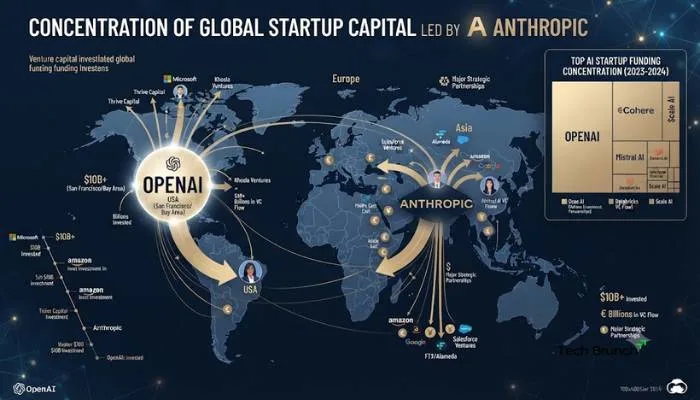
Almost all of that money went to a small group of companies. OpenAI and Anthropic alone took 43% of the total. M&A is also surging, on track for its second-best year ever. The rules have shifted. Capital is concentrated. AI dominates. This is not a hype cycle. It is a realignment. This guide breaks down what is happening and what it means for founders and investors.
The AI Investment Boom
Artificial intelligence is the main story. More than 70% of global startup capital in Q2 2026 went to AI-focused companies, up from under 50% a year earlier . This is not just hype. It is a structural shift. Investors are betting that AI will reshape every industry.
The OpenAI and Anthropic Effect
OpenAI and Anthropic have become the giants of this cycle. Anthropic raised $65 billion in a single quarter and became the most valuable private company on the Crunchbase Unicorn Board . The company is backed by Altimeter Capital, Dragoneer, Greenoaks, Sequoia Capital, Amazon, and Google . This level of concentration is unprecedented.
Beyond the Top Two
Other frontier labs also raised massive rounds. DeepSeek, StepFun, and Moonshot AI from China joined the list. UK-based Ineffable Intelligence and US-based Prometheus and Isomorphic Labs also raised billion-dollar rounds . Alongside foundation model companies, large funding rounds went to startups working on defense, AI infrastructure, robotics, and healthcare .
Read More: India Fintech Funding 2026: Trends, Deals and Startups
Startup Funding Trends 2026 India
India tells a different story. Technology startups raised $7.2 billion in the first half of 2026, a 12% year-on-year increase . But deal count fell sharply, down 43% to 652 rounds . This mirrors the global trend of fewer, larger bets.
Top Deals in India
The top three funding rounds dominated. CRED raised $900 million. Nxtra raised $710 million. Neysa raised $600 million. These three deals alone accounted for nearly 31% of all capital deployed in the period . This shows how concentrated Indian startup funding has become.
AI Startups Reach Unicorn Status Faster
AI-native startups are achieving unicorn status faster than companies in other sectors. Neysa and Sarvam crossed the $1 billion valuation mark in less than three years . In contrast, KreditBee, Skyroot, and Square Yards took between eight and twelve years . Speed matters in this new environment.
M&A Activity 2026: A Record Year
Global M&A activity is on course for its second-strongest year ever. Deal value climbed 41% year-over-year to $2.4 trillion in the first five months of 2026 . The full-year total is on track to exceed $5.3 trillion, just below the all-time record of $5.6 trillion set in 2020 .
Mega-Deals Dominate
Transactions valued at more than $10 billion are driving the market. These mega-deals are up 52% in number and 53% in value compared with the same period last year . The largest startup acquisition ever took place in Q2 2026. SpaceX agreed to acquire Anysphere, maker of the AI coding tool Cursor, for $60 billion .

The SpaceX IPO
SpaceX also went public at a value of $1.77 trillion, raising $75 billion . Less than a week later, it confirmed its intent to acquire Cursor. This two-step move showed how the biggest companies are using both public markets and acquisitions to scale.
The Winner's Paradox
Companies striking large deals now face what Bain calls the "winner's paradox". They must execute a large-scale acquisition while simultaneously overhauling their operations for an AI-driven economy. "It has rarely been harder to get large, complex transactions right, yet they represent the single biggest opportunity if you do," said Suzanne Kumar, executive vice president of Bain's global M&A practice .
M&A Market Trends
The M&A market is becoming increasingly selective. Global deal volume softened to 20,355 transactions in H1 2026, down 7% from the previous period . But average deal value in Q2 2026 was £308 million, up 50% year-on-year . This shows that companies are still willing to pay for quality assets.
Strategic Buyers vs Financial Sponsors
Strategic buyers are leading the charge. Strategic deal value rose 31% quarter-over-quarter in Q2 2026. Financial sponsor deal value declined 9% . Corporate venture activity surged 206% in value, driven in part by OpenAI's $122 billion funding round . Companies are using their balance sheets to buy capabilities.
Sector Concentration
Technology remains the largest M&A sector globally, accounting for 23% of all announced activity in 2026 . Industrials and Energy & Power follow closely behind. AI's influence now extends far beyond the technology sector itself, shaping acquisitions involving infrastructure, energy generation, and industrial capacity .
The Rise of Cross-Border M&A
Cross-border mid-market M&A reached €197 billion in value, a 16.7% increase in deals . North American and European businesses lead more than 75% of all deals. US buyers are focusing on the UK, Israel, and India, all hotbeds of technology development . IT deals are the most sought-after, with 26% of cross-border mid-market deals relating to AI.
Europe's Domestic Focus
Europe has emerged as a particular hotspot. Deal value across EMEA is up 77% year-over-year through May, fueled by domestic consolidation and cross-border bids . However, sharp falls in inbound activity are being offset by resilient domestic dealmaking . This shows a focus on home-market M&A.
The Asia-Pacific Picture
Asia-Pacific remains comparatively subdued. Regional M&A declined 8% year-on-year despite an increase in deal count. Japan recorded a 43% decline in announced value . The recovery is increasingly concentrated in developed Western markets.
You May Also Read: Latest Startup Funding News This Week: AI Leads India
Key Takeaways for Startups

2026 is not a hype year. It is a reality check. The era of undifferentiated funding waves is ending. Substance now outweighs unconditional scaling . Here is what founders need to know.
Capital Efficiency Matters
Investors are demanding significantly higher commercial quality and operational performance . Successful founders plan extremely capital-efficiently and with sufficient buffers for delays. They do not burn through cash. They show a clear path to profitability.
Speed Is Everything
Performance expectations are rising. Successful founders focus on speed in decision-making, product development, and market entry . They test quickly and accept uncertainty where others seek reassurance.
AI Readiness Is Critical
Companies that are AI-ready are separating from the pack. Whether you are a startup or an established business, your ability to use AI will determine your attractiveness as an acquisition target . Scale and AI readiness are increasingly the criteria separating attractive targets from those left behind.
FAQs
1. What is the state of startup funding in 2026?
Global startup funding hit a record $510 billion in the first half of 2026. This surpassed the $440 billion invested in all of 2025. However, capital is highly concentrated in a handful of AI companies. OpenAI and Anthropic alone accounted for 43% of all funding .
2. What are the startup funding trends 2026 in India?
India raised $7.2 billion in the first half of 2026, up 12% year-on-year. Deal count fell sharply to 652 rounds. The top three deals (CRED, Nxtra, Neysa) accounted for nearly 31% of the total . AI startups are reaching unicorn status faster than other sectors.
3. What is driving M&A activity 2026?
Global M&A is on course for the second-highest year ever. Deal value rose 41% to $2.4 trillion in the first five months of 2026. Mega-deals over $10 billion are driving the market, up 52% in number . The SpaceX-Cursor acquisition for $60 billion was the largest startup acquisition ever.
4. What are the key M&A market trends for 2026?
M&A is becoming increasingly concentrated. Deal volumes are down, but deal values are up. Strategic buyers are leading the charge while financial sponsors are pulling back. Technology, industrials, and energy are the most active sectors . AI now influences deals across all industries.
5. What are the main startup trends 2026?
AI dominates. Over 70% of global startup capital in Q2 went to AI companies. Founders are focusing on capital efficiency and clear paths to profitability. Speed in decision-making and product development is critical . AI readiness is becoming a key factor in startup valuation and acquisition attractiveness.
6. How are cross-border M&A trends shaping up?
Cross-border mid-market M&A reached €197 billion in value. US buyers are focusing on the UK, Israel, and India. Europe is seeing a focus on domestic deals. Asia-Pacific remains subdued . IT deals are the most sought-after, with 26% of cross-border mid-market deals relating to AI.
7. What is the "winner's paradox" in M&A?
Bain & Company identified this phenomenon. Companies winning large deals must simultaneously execute complex integrations and overhaul their operations for an AI-driven economy. It has rarely been harder to get large transactions right, but they represent the single biggest opportunity if you do .