
Startup valuation feels like a mystery. Investors throw out numbers and you wonder how they got there. The truth is, early-stage valuations are not about current revenue. They are about potential. This guide explains how startup valuation is calculated in simple terms. We cover the main methods investors use.
The Berkus Method for pre-revenue companies. The Scorecard Method that compares you to peers. The VC Method that works backwards from a future sale. And the dilution math that most seed deals actually use. No confusing formulas. Just clear explanations to help you understand what investors are thinking and how to negotiate your round.
Why Startup Valuation Is Different?
Valuing a startup is not like valuing a bakery or a factory. Established businesses have revenue, profit, and cash flow history. You can look at past performance and project forward. Startups often have none of that.
Most early-stage startups have never generated positive cash flow or even revenue . Traditional methods like Discounted Cash Flow (DCF) do not work well here. There is not enough data .
Instead, startup valuations are based on future potential. Investors look at market size, team quality, and traction. They ask: "How big could this company become?"
Read More: Best SaaS Startup Ideas for Beginners to Launch in 2026
Key Factors That Drive Valuation

Investors evaluate startups using four main factors :
Your Market
Is it large and growing? Investors want a huge opportunity. A $100 million market is small. A $10 billion market gets attention.
Your Team
Do you have the right people? Industry experience, complementary skills, and past success matter. A founder with an exit history can aim higher .
Your Traction
Do you have users, partners, or market interest? Even without revenue, traction matters. Waitlists, active users, pilot customers, and signed LOIs all count . Being consistent with your metrics is key .
Your Product
Is it different? Does it have a defensible advantage? Patents, proprietary tech, or strong differentiation support a higher valuation .
Common Methods for Startup Valuation
Berkus Method
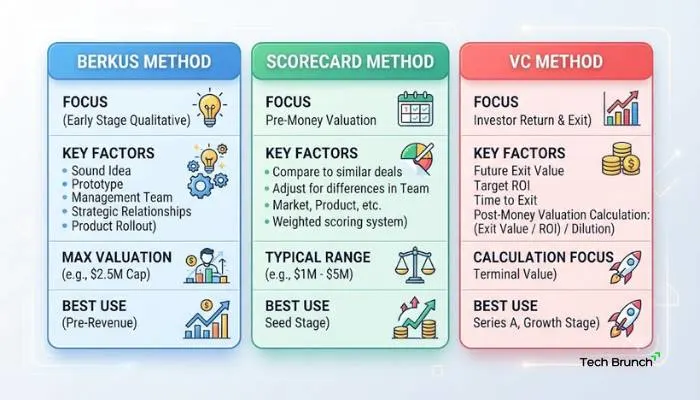
The Berkus Method is for pre-revenue startups. It assigns value to five factors :
- Basic value of the idea or market potential
- Development stage of the product or prototype
- Quality and experience of the founding team
- Strategic relationships and partnerships
- Progress toward launch and early sales
Each factor can add up to $500,000. The maximum valuation is $2.5 million . This method keeps early-stage valuations grounded .
Scorecard Method
The Scorecard Method compares your startup to others in your industry and region . First, you find the average pre-money valuation of similar startups. Then you score your company on seven categories :
| Category | Weight |
|---|---|
| Management team | 25% |
| Market size and timing | 15% |
| Product or technology | 15% |
| Marketing and sales strategy | 10% |
| Competitive environment | 10% |
| Need for funding | 10% |
| Other factors | 15% |
A score of 100% means you are on par. Above 100% means you are above average. Multiply the weighted score by the average valuation to get your number .
Venture Capital (VC) Method
The VC Method works backwards from a future exit . Here is how it works:
- Estimate the startup's value at exit (IPO or acquisition)
- Apply a profit multiple to get the future valuation
- Work backwards based on the investor's expected return
This method focuses on what the company could become, not what it is today .
Multiples Method
For startups with revenue, the Multiples Method is common :
- SaaS startups: 8-15x Annual Recurring Revenue (ARR)
- Marketplace startups: 1-5x Net Revenue
The exact multiple depends on growth rate, gross margin, and market conditions. Higher growth commands higher multiples .
Cost-to-Duplicate
This method calculates how much it would cost to build the startup from scratch . It includes the cost of developing the product, acquiring assets, and hiring a team. This is a conservative method. It does not account for future potential.
You May Also Read: Profitable SaaS Startups in 2026: Who Is Making Money?
The VC Reality: Valuation Often Starts with Dilution
Venture capitalists often use a simpler approach. They know how much money you are raising. They also know how much ownership they need to justify their time and risk.
Peter Pham, Co-founder of Science, puts it bluntly: "Valuation is really based on how much money the founders think they need. Every round you're giving up 20 or 25 or up to 30%" .
Here is how it works. You want to raise $2 million. Investors want 20% ownership. The implied valuation is $10 million ($2 million / 20%) . It sounds simple. But this is how many seed deals actually get priced.
How to Value a Startup Without Revenue?
No revenue does not mean no traction. You have other signals you can show investors :
- Active users (define what counts as active and stick to it)
- Retention by cohort
- Repeat usage
- Waitlist quality (who they are and why they joined)
- Paid pilots (even small ones count)
- Signed LOIs with clear scope
- Partnership terms (not just logos)
- Sales pipeline with named stages
Be consistent with your definitions . Investors will forgive small numbers. They will not forgive shifting definitions.
Common Mistakes to Avoid
- Overvaluing your startup. A high valuation seems good. But if you cannot justify it in the next round, you face a down round. That hurts morale and dilutes founders more .
- Undervaluing your startup. You give away too much equity too early. You lose control and motivation .
- Ignoring traction. Even pre-revenue, show evidence of adoption. Waitlists, downloads, proof of concepts with customers .
- Comparing to giants. Do not say "Stripe is worth X, so we should be worth Y." Stay in your lane.
Recent Valuation Benchmarks
Median startup valuations by funding round in 2025 :
| Round | Median Valuation |
|---|---|
| Pre-Seed | $1.2 million |
| Seed | $6.4 million |
| Series A | $25.3 million |
| Series B | $56.9 million |
| Series C | $103.3 million |
| Series D | $460.1 million |
In Europe, median pre-seed and seed valuations in early 2026 are around €4.7 million to €5.0 million .
The Bottom Line
Startup valuation is more art than science in the early stages. There is no single formula. You use multiple methods and triangulate a range. The Berkus and Scorecard methods work for pre-revenue companies. The VC method and market comparables work when you have some data.
The most practical approach for most seed founders is to work backwards from the raise. Figure out how much money you need to hit your next milestones. Decide how much equity you are willing to give up. The valuation follows from there.
Bring evidence to every conversation. Show traction, even if it is small. Be consistent with your metrics. And be realistic. A fair valuation that keeps your investors happy is better than a high number that sets you up for failure.
FAQs
1. How do you value a startup with no revenue?
Look at other things. Active users. How many people stay. Who is on your waitlist. Any paid pilots. Signed letters of intent. The Berkus Method looks at your team, technology, and relationships. The Scorecard Method compares you to other startups. No revenue does not mean zero value.
2. What valuation method do VCs actually use?
Most seed deals use dilution math. You decide how much money you need. You decide how much ownership to give up. Valuation comes from that. Raise $2 million for 20% equity. That is a $10 million valuation. Simple.
3. What is a fair seed valuation?
Median seed valuation in 2025 was $6.4 million. Pre-seed was $1.2 million. These are averages, not rules. Your team, market size, and traction matter more. A fair number keeps everyone happy. Too high and you may struggle in the next round.
4. How do VCs think about pre-revenue startups?
They work backwards. Estimate what the company could sell for in 5-7 years. Then discount to today based on their target return. Think the company could be worth $100 million and want a 10x return? That gives a $10 million valuation today.
5. What mistakes do founders make?
Overvaluing. High numbers feel good but lead to down rounds. Undervaluing means you give away too much equity. Comparing to giants like Stripe. Using numbers that do not match up. Be real, be consistent, and focus on traction. A fair deal beats a big number.