Danggeun Market, the startup behind Karrot, South Korea’s largest neighborhood marketplace and networking app, announced today that that it has raised a $33 million Series C. The round was led by Goodwater Capital and Altos Ventures.
The funding brings Danggeun Market’s total raised so far to $40.5 million. Its list of investors also include Kakao Ventures, Strong Ventures, SoftBank Ventures and Capstone Partners. Danggeun Market, which launched Karrot in the United Kingdom last November, will use part of the funding to expand into more international markets and increase its monetization tools.
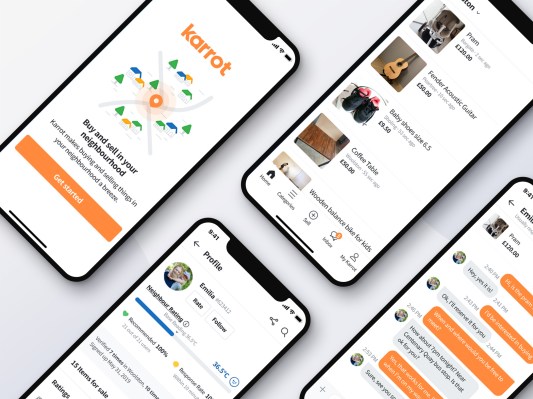
One of Karrot’s most unique features is that its peer-to-peer marketplace only shows people listings from sellers located within a 6-kilometer radius (the distance is set slightly wider for more remote areas), and most transactions are completed in person. As a safety measure, all user identities are verified through their mobile numbers and location.
In a call with TechCrunch, Danggeun Market co-founder and co-CEO Gary Kim and vice president Chris Heo said Karrot’s model works because of the high population density in many South Korean cities. As the app launches overseas, the company will focus on other densely populated areas, especially ones that don’t already have a dominant neighborhood marketplace app.
Danggeun Market planned to enter three new countries this year, but slowed down the pace of its expansion because of the COVID-19 pandemic. Instead, it will focus on enhancing its community features in South Korea, with the goal of launching in at least one new country by the end of this year.
Danggeun Market was founded in 2015 by Gary Kim and Paul Kim, both of whom previously worked at KakaoTalk, South Korea’s largest messaging app. Before Danggeun Market launched, the most popular online secondhand marketplace in South Korea was website Joonggonara, but it didn’t have a mobile app.
Being designed for smartphones helps Karrot differentiate from other peer-to-peer marketplaces. For example, its distance limits make listings easier to spot, and also encourages interactions among neighbors. Its approach to neighborhood networking is also the foundation of the company’s monetization model. Instead of charging listing fees, the app is free to use, and the company makes money through hyperlocalized advertising.
Danggeun Market says its monthly active users have grown 130% year-over-year, reaching seven million in April and making Karrot the second-largest shopping app in South Korea after Coupang, the country’s largest e-commerce platform. Users spend an average of 20 minutes per day on the app, and gross merchandise value increased by 250% year-over-year, despite the COVID-19 pandemic.
Heo said the number of listings on the app actually grew from 4.4 million in January to 8.4 million in April, as more people spent time at home and found things they wanted to get rid of, and also preferred to remain within their neighborhoods. Danggeun Market’s community features also saw a jump in the number of postings made.
Heo said face-to-face transactions continued, because many South Koreans were already used to wearing masks and other safety measures that were ramped up during the pandemic. The company added a new feature called Karrot Help, with tools to help match people with neighbors who needed help running errands and a mask inventory checker for nearby pharmacies, and implemented tools to automatically control the price of mask listings and prevent profiteering.